

The Map Is Getting Dangerous
A progress report from inside the Earl Douglas genetic investigation

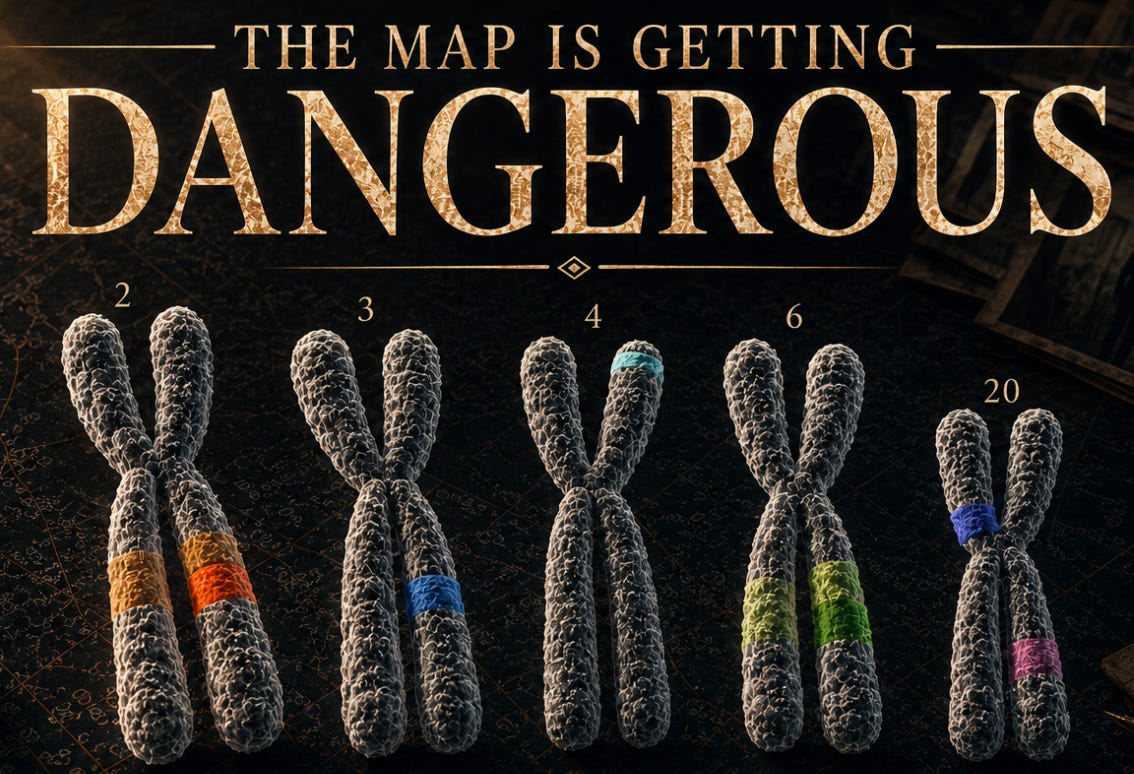
I could’ve easily paid a professional genealogist to work this case.
It probably would’ve been cheaper than all the traveling and platform subscriptions I’ve paid for over the years.
I’ve had friends doing this kind of work offer to help.
I never took anyone up on it.
Not because there was some grand plan. The case has always had its hooks in me, and handing it off never felt like an option.
Maybe that was stubbornness.
Maybe it was grief wearing a work shirt.
Maybe it was the strange arrogance that comes from staring at a family mystery long enough to believe it’s chosen you personally.
Within the last six months, my research has turned into a much deeper investigation.
I realized I wasn’t going to solve the mystery of my great-grandfather Earl Mack Douglas by waiting around for one perfect record to stroll out of the fog wearing a name tag.
I wasn’t going to be rescued by one magical DNA match.
I wasn’t going to open a census page, hear trumpets, and watch the lost parents of Earl Mack Douglas rise from the dust like saints in a courthouse basement.
The paper trail had already failed.
It had failed hard.
It had failed in that cold bureaucratic way records fail when a child needed a name, a family, a story, and the system handed him a blank slip.
No parents listed.
Four words if you count the silence.
A wall dressed up as a record.
If I wanted the truth, I had to stop begging the paper trail to confess. I had to learn how to read what has survived in the chromosomes.
That’s where I am now.
Not at the end.
Not even close.
But I’m no longer standing outside the locked door with my face pressed against the glass.
For years, the story of Earl Mack Douglas has been trapped behind the same brutal fact. A child appears in the records, later described as a foundling, later taken from a home in Duluth, later raised sixty miles south of Duluth-Superior in Minong, Washburn County, Wisconsin. Every normal genealogical road that should lead backward from him breaks down in the ditch.
The records don’t open.
They cave in.
When the paper trail failed, I did what most genealogists do. I kept looking for more paper.
Another census.
Another city directory.
Another court record.
Another church register.
Another scrap in the attic of history.
I searched Duluth. I searched Wisconsin. I searched the families around him. I searched the people who took him in. I searched the names that circled the story like wolves in the timber.
But paper has limits.
DNA does too, but it fails differently.
Paper goes silent.
DNA gets messy if you don’t understand how to use it or ask it the right questions.
That mess is where the case lives now.
Over the last several weeks, the Earl Douglas Genetic Investigation has shifted from ordinary genealogy into something closer to forensic reconstruction. I’m no longer chasing every surname that looks interesting. I’m no longer building giant speculative trees because a match has a tempting ancestor hiding six generations back. I’m no longer letting the internet drag me into the swamp with every copied family tree, unsourced colonial fantasy, and digital cousin trap waiting to eat a weekend alive.
The rule now is simple:
Target groups first.
Chromosome map second.
People later.
That rule changed everything.
It forced the investigation to slow down where it needed discipline and speed up where it had evidence. It stopped me from trying to solve Earl’s parentage by force. It turned the work into a disciplined map of surviving chromosome structures, one piece at a time.
The map isn’t the answer yet.
But it’s becoming real.
And in a case where the paper trail failed before it ever had the decency to tell the truth, real matters.
This is no longer just a mystery. It’s a structure problem.
When people hear “DNA genealogy,” they often imagine match lists. They imagine cousins, trees, surnames, and maybe a Leeds chart with colored columns lined up like a polite little parade.
This isn’t that.
This is what happens after the Leeds chart takes off its coat and starts kicking doors in.
I’m working with chromosome segments, triangulated groups, maternal controls, GEDmatch evidence, FTDNA AutoSegment clusters, DNA Painter maps, and a growing system of target groups. Each target group represents a possible surviving fragment of Earl’s unknown ancestry. Some are stronger than others. Some are confirmed. Some are candidate structures. Some are parked because they’re interesting but not yet worth the labor.
That last part is important.
Not every clue deserves a shovel.
Not every surname gets a trial.
Not every match gets to become a theory.
The work isn’t to stare at a DNA match and say, “That person has a Castle in their tree, therefore Earl must descend from Castle.”
That would be garbage.
That would be genealogy with a concussion.
The work is to ask harder questions.
Do multiple people share the same DNA segment?
Do they triangulate?
Does my kit sit inside the structure?
Does the maternal-control kit appear there?
Is this actually on Earl’s side?
Is this one family signal, or just surname glitter?
Is the same chromosome region showing up across independent people?
Can the segment be painted?
Can it survive audit?
Can it be kept separate from neighboring structures?
Can it carry enough weight to justify tree reconstruction?
That’s the work now.
That’s the discipline.
That’s the grind.
And this week, the map got bigger.
A couple of weeks ago, when the possible Isaac Castle link surfaced, I realized the workflow had to change. Family-tree research is far more labor-intensive than mapping matches into target groups and verifying chromosome structures. If I chased every promising surname too early, the case would drown in trees before the chromosome map had a chance to speak.
I got lucky with the Castle matches. They pointed in the same general direction fast enough to get my attention. But luck is not proof, and the minute I started building those lines backward, I could see the swamp opening up. These matches run straight into the messiest, most questionable regions of their family trees, the places where records get thin, names start floating, surnames reoccur, and copied online trees begin breeding like rats in the walls.
It’s much easier to query DNA matches and work directly with the segment data. That evidence is cleaner. It can be tested, compared, mapped, triangulated, and audited. It does not depend on whether somebody’s online tree has quietly swallowed three bad generations and a fantasy ancestor from colonial New England.
Family-tree research is different. Once the line gets questionable, everything slows down. Missing records, copied errors, uncertain parentage, weak dates, duplicate names, bad geography, and unsourced claims all have to be documented, challenged, and written out in a report. That work matters, but it is expensive in time and attention.
That is why I’m building the chromosome map first. The DNA tells me which trees deserve the labor.
That is why the genealogy has to come last. The chromosome map has to lead.
I know plenty of family researchers and genealogists who get uneasy around genetic evidence. I was one of them. Chromosome browsers, triangulated segments, target groups, maternal controls — it all looked like a foreign language until I stopped treating it like a wall and started asking better questions.
Once I did that, something surprised me: the DNA work was often cleaner than the document work. Not easier in the sense of simple, but easier in the sense of testable. A segment can be compared. A match can be checked. A target group can be built, challenged, painted, and audited.
A questionable family tree is different. That is where the ground turns soft. Missing records, copied mistakes, bad dates, weak parentage claims, and unsourced ancestors all have to be dragged into daylight and written out. That work matters, but it should not lead the investigation.
The DNA tells me where the tree work deserves to begin.
Target groups first. Structure next. People (matches) later. Otherwise, I’ll burn through months chasing shaky ancestors before the DNA has even told me which trees deserve the labor.
TG-02: chromosome 3 stopped being a maybe
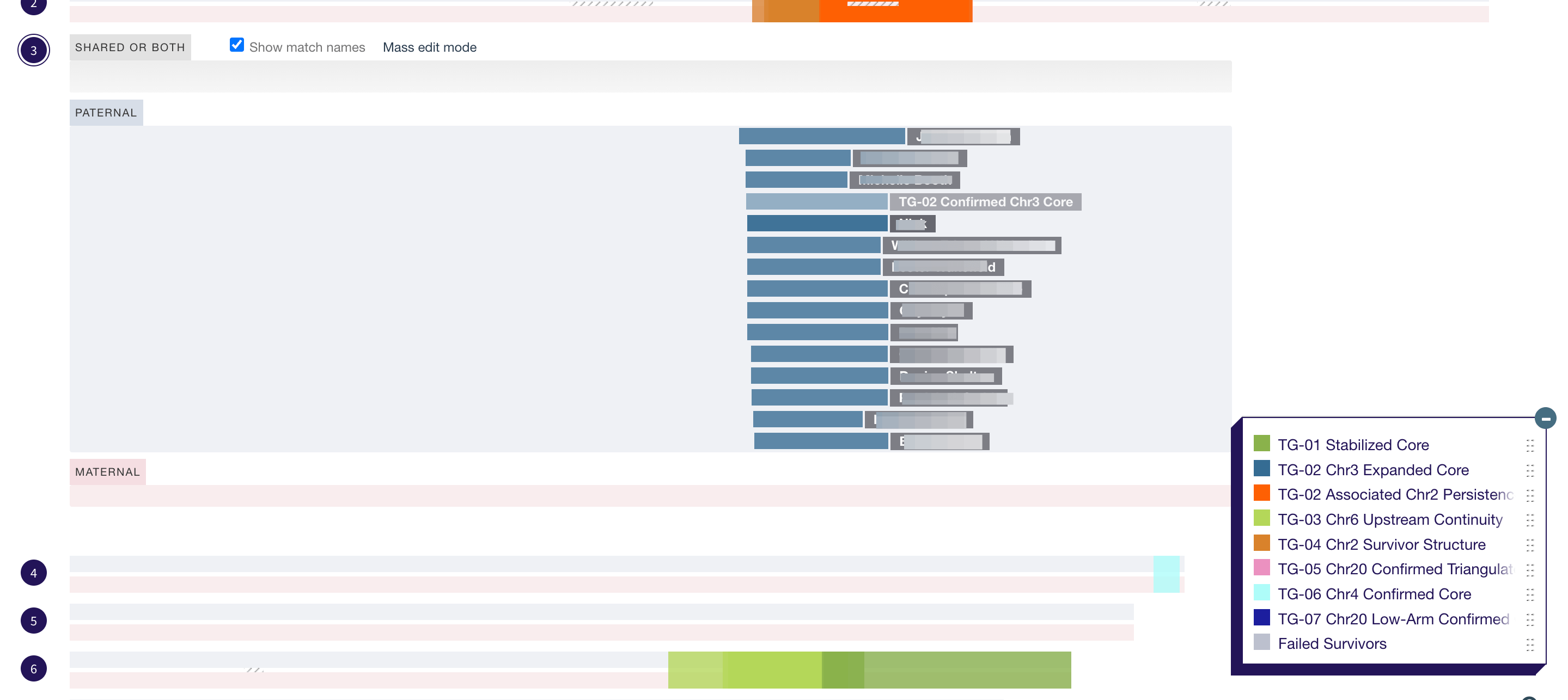
The first major event in this round was closing the TG-02 FTDNA cycle.
TG-02 is the chromosome 3 structure. It’s been one of the strongest pieces in the case for a while, but strength isn’t enough. In this investigation, a target group doesn’t get to live on vibes.
It has to survive evidence.
TG-02 did.
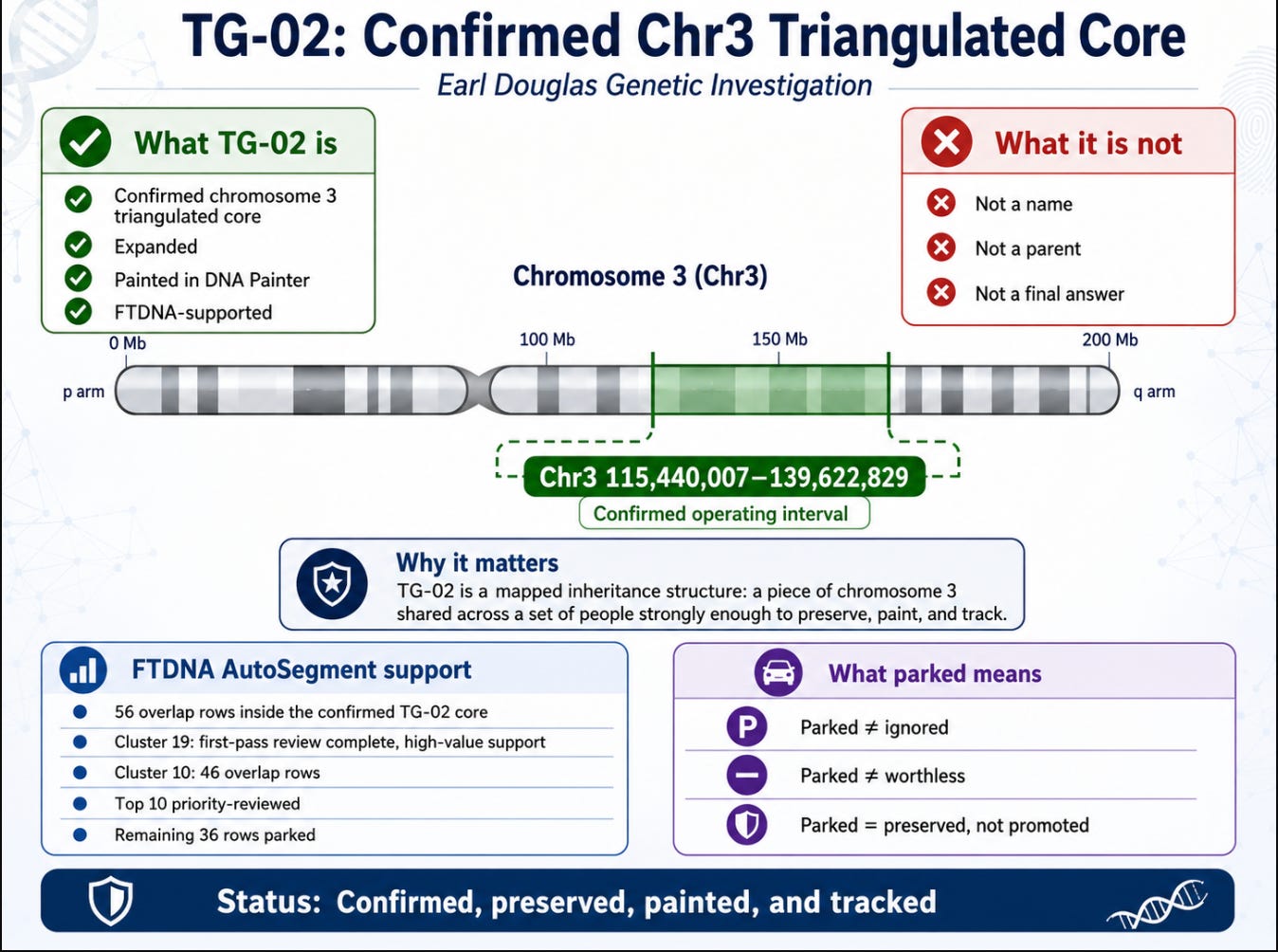
It’s now preserved as a confirmed chromosome 3 triangulated core that has been expanded, painted in DNA Painter, and supported by FTDNA AutoSegment evidence.
The confirmed operating interval is:
Chr3 115,440,007 to 139,622,829.
That’s not a name.
That’s not a parent.
That’s not a final answer.
But it’s a mapped inheritance structure. It’s a piece of chromosome 3 shared across a set of people strongly enough to preserve, paint, and track.
In a case like Earl’s, that kind of structure is gold with dirt under its fingernails.
The FTDNA AutoSegment work strengthened TG-02 further. It identified 56 overlap rows inside the confirmed TG-02 chromosome 3 core. Cluster 19 received a first-pass review and came out as high-value support. Cluster 10 produced 46 overlap rows, and the top 10 were priority-reviewed.
The remaining 36 rows weren’t discarded.
They were parked.
That distinction matters.
Parked doesn’t mean ignored.
Parked doesn’t mean worthless.
Parked means preserved, not promoted.
It means I’m not going to chase every row just because it exists. I’m not going to let the investigation turn into a slot machine where every new match gets a pull and every pull promises the jackpot.
That’s how you lose months.
That’s how you mistake motion for progress.
TG-02 is now strong enough to preserve and park.
It’s confirmed.
It’s expanded.
It’s painted.
It’s FTDNA-supported.
It’s source unresolved.
No MRCA has been assigned.
No surname-source has been assigned.
No parent candidate has been named.
That last part is frustrating, but it’s also the reason the investigation is still honest.
The chromosome map is improving.
The case isn’t solved.
Both things can be true.
TG-05: chromosome 20 tightened its jaw
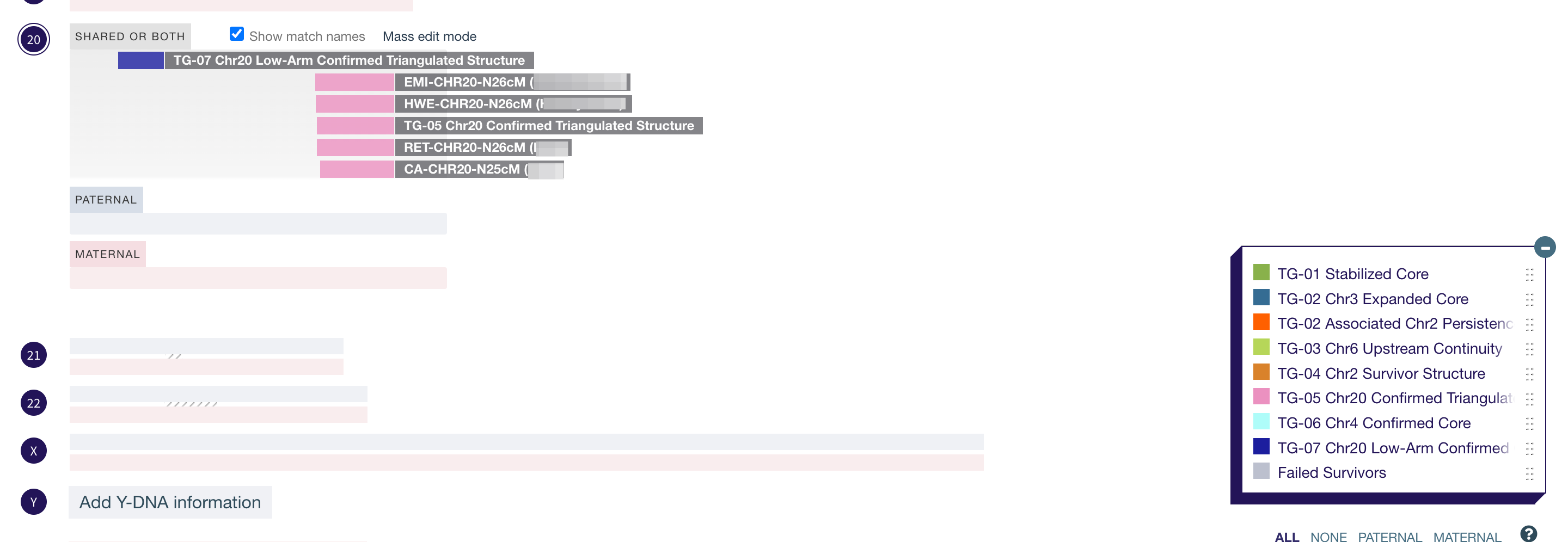
After TG-02 was parked, the workbench shifted to TG-05.
TG-05 is a chromosome 20 structure. Earlier, it was a strengthened candidate. It had signal, but signal isn’t enough. It needed tightening. It needed boundaries. It needed dependency control. It needed to survive the maternal-control question.
The central problem wasn’t whether there was something there.
There was clearly something there.
The question was whether the structure could hold up without pretending close relatives were independent witnesses.
That matters because TG-05 includes a dependency-cautioned pair. These two participants share enough DNA with each other that they can’t be counted as two clean independent source witnesses. Their relationship may strengthen a downstream family path, but it can’t be allowed to inflate the deeper ancestral claim.
That isn’t a detail to bury.
That’s a warning flare.
In genetic genealogy, independence matters. If two matches are closely related to each other, they may strengthen one branch, but they don’t automatically strengthen the deeper ancestral case. If I counted them as independent when they’re not, I’d be building a false tower and calling it evidence.
That’s how bad conclusions get dressed up in technical language.
So TG-05 had to be handled carefully.
The tightening pass completed the required one-to-one comparisons. My kit matched the TG-05 chromosome 20 structure. The key TG-05 participants matched each other in the expected region. The dependency-cautioned pair remained flagged.
Then the maternal-control kit was tested.
The maternal-control kit didn’t appear inside the TG-05 chromosome 20 triangulated output.
That matters.
It means TG-05 survived the maternal-control screen.
The tightened working core is now:
Chr20 42,172,112 to 55,390,948.
DNA Painter format:
20 42172112 55390948.
Painted size:
26.3 cM.
TG-05 has now moved from a strengthened candidate into a confirmed chromosome 20 triangulated structure, MKA supported, maternal-control clean, and source unresolved.
Again, that isn’t a source conclusion.
It doesn’t identify Earl’s parents.
It doesn’t prove a surname.
It doesn’t assign an MRCA.
It doesn’t authorize a weekend bender through 900 online trees, three genealogy forums, and somebody’s unsourced colonial fever dream from 2007.
It means the chromosome structure is real enough to keep.
That’s the point.
Build the group.
Paint the chromosome.
Delay the trees.
The DNA Painter audit: cleaning the crime scene
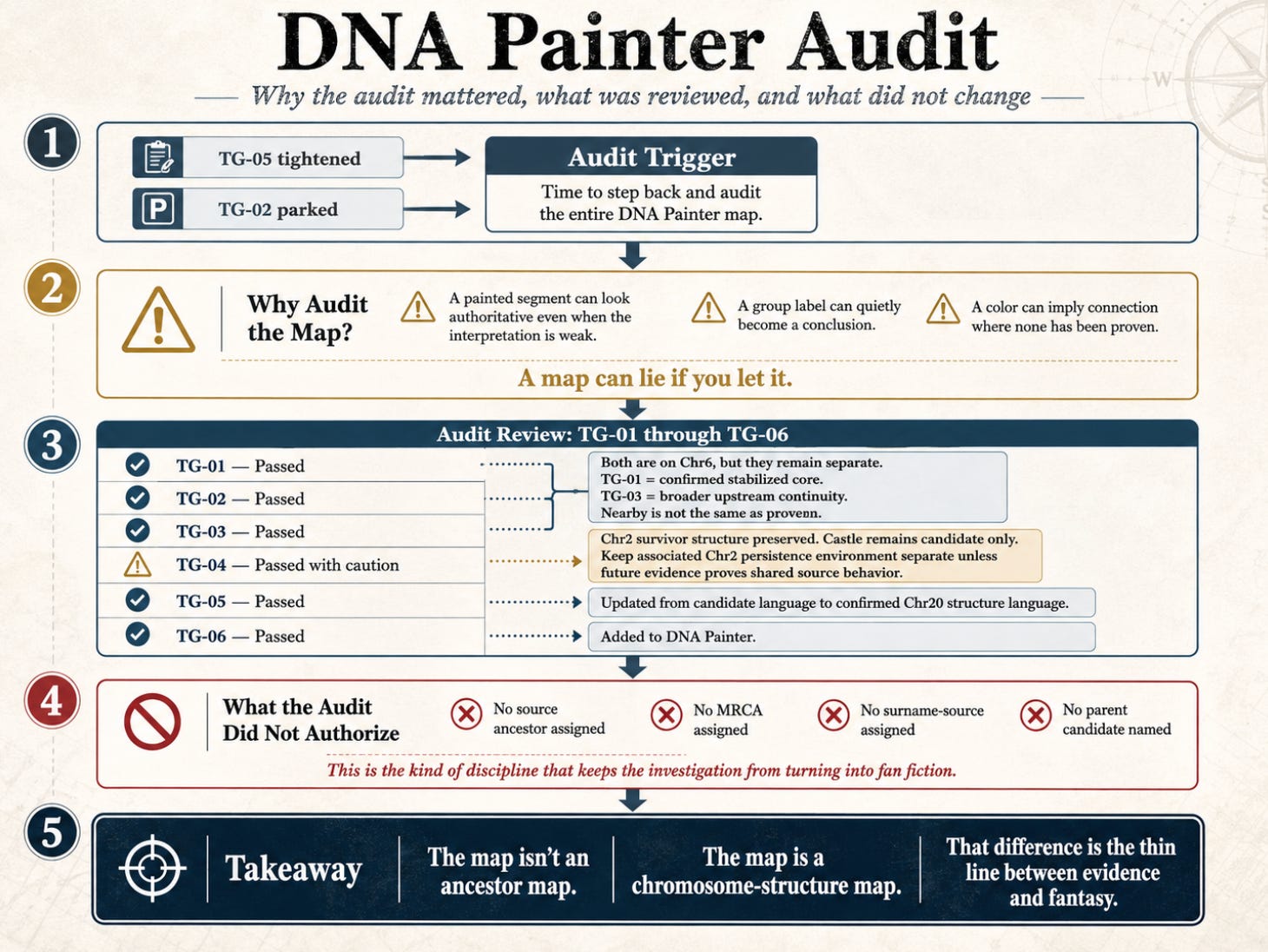
Once TG-05 was tightened and TG-02 was parked, I had to step back and audit the whole DNA Painter map.
This wasn’t glamorous work.
This was the equivalent of sweeping the crime scene, labeling the evidence bags, checking the chain of custody, and making sure nobody taped a confession to the wrong wall.
DNA Painter can become dangerous if it turns into a pretty picture instead of an evidence tool. A painted segment can look authoritative even when the interpretation behind it is still weak. A group label can quietly become a conclusion if you’re not careful. A color can imply connection where none has been proven.
A map can lie if you let it.
So the audit mattered.
The DNA Painter audit reviewed TG-01 through TG-06.
TG-01 passed.
TG-02 passed.
TG-03 passed.
TG-04 passed with caution.
TG-05 passed.
TG-06 passed.
That sounds clean, but the caution is where the truth lives.
TG-04 passed because the chromosome 2 survivor structure is real enough to preserve. But Castle remains candidate only. The associated chromosome 2 persistence environment remains separate unless future evidence proves shared source behavior.
TG-01 and TG-03 both live on chromosome 6, but they remain separate. TG-01 is the confirmed stabilized core. TG-03 is the broader upstream continuity structure. They don’t get merged just because they’re nearby.
Nearby isn’t the same as proven.
Pretty isn’t the same as true.
TG-05 was updated out of candidate language and into confirmed chromosome 20 structure language.
TG-06 was added to DNA Painter.
No source ancestor was assigned to any active group.
No MRCA was assigned.
No surname-source was assigned.
No parent candidate was named.
That’s the kind of boring sentence that saves an investigation from becoming fan fiction.
The map isn’t an ancestor map.
The map is a chromosome-structure map.
There’s a difference.
And that difference is the thin line between evidence and fantasy.
TG-06: another piece enters the board
TG-06 is the chromosome 4 structure.
It was promoted after GEDmatch triangulation, my kit’s anchor confirmation, and direct maternal exclusion testing. The confirmed interval is:
Chr4 184,886,694 to 189,402,769.
The broader observed support region is approximately:
Chr4 184,609,457 to 189,545,795.
My kit’s anchor testing passed 9 of 9.
Maternal exclusion testing passed 9 of 9.
That makes TG-06 a confirmed chromosome 4 triangulated core.
It’s painted.
It’s documented.
It’s source unresolved.
That phrase keeps appearing because it has to.
Source unresolved.
Source unresolved.
Source unresolved.
It’s the drumbeat under the whole investigation.
A confirmed segment isn’t a confirmed ancestor.
A triangulated group isn’t a parent.
A surname in a tree isn’t proof.
Every time I forget that, the case gets sloppier.
Every time I remember it, the map gets sharper.
TG-07: chromosome 20 had another survivor hiding in plain sight
After the audit, I went hunting for the next target group.
This is where things got interesting.
I searched outside the known active target zones. The point wasn’t to reinforce what I already had. The point was to find a new structure without confusing it with an existing one.
That led to TG-07.
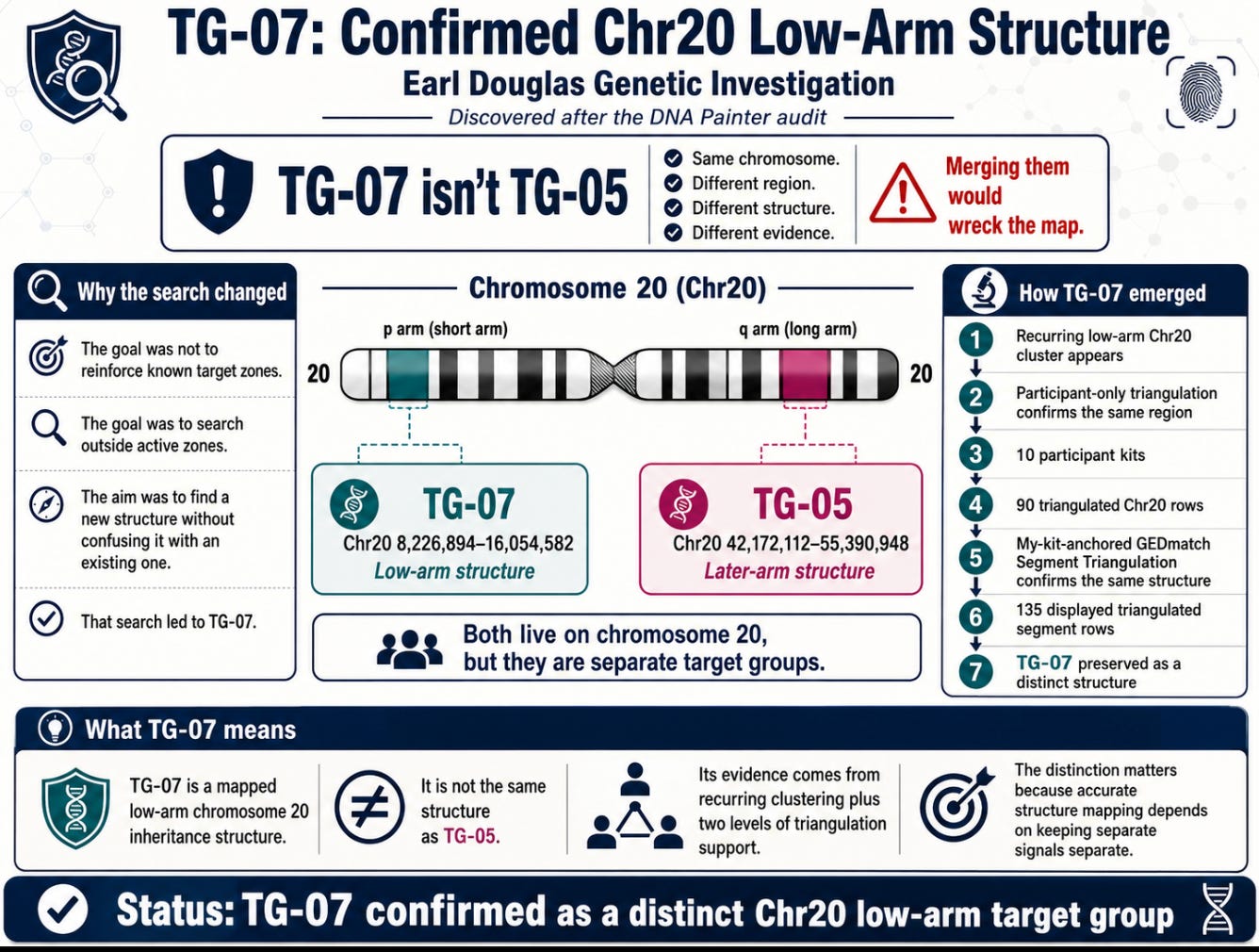
TG-07 lives on chromosome 20, but it isn’t TG-05.
That distinction matters so much I’m going to say it again:
TG-07 isn’t TG-05.
TG-05 is the later-arm chromosome 20 structure:
Chr20 42,172,112 to 55,390,948.
TG-07 is the low-arm chromosome 20 structure:
Chr20 8,226,894 to 16,054,582.
Same chromosome.
Different region.
Different structure.
Different evidence.
If I treated them as one thing just because both live on chromosome 20, I’d wreck the map and deserve the mess.
TG-07 first appeared as a recurring low-arm chromosome 20 cluster. Participant-only triangulation confirmed the same region among 10 participant kits and produced 90 chromosome 20 triangulated rows. Then the my-kit-anchored GEDmatch Segment Triangulation confirmed the same structure and produced 135 displayed triangulated segment rows.
Then came the maternal-control check.
The maternal-control kit produced zero triangulated segments.
That was the moment TG-07 could move.
It was promoted from candidate to confirmed:
TG-07 Chr20 Low-Arm Triangulated Structure, my-kit-anchored, maternal-control clean, painted, source unresolved.
The confirmed working core is:
Chr20 8,226,894 to 16,054,582.
DNA Painter format:
20 8226894 16054582.
The broader observed support region is:
Chr20 approximately 4,967,355 to 20,144,772.
TG-07 got its own DNA Painter group, its own color, its own log, its own daily progress report, and its own place in the Active Investigation Board and Registry.
From the outside, that may look small.
Another segment.
Another file.
Another line in a table.
But inside the case, this is a new surviving fragment of Earl’s unknown ancestry.
Not the answer.
Not the name.
Not the parents.
But another piece of the map that didn’t exist before.
The case didn’t solve.
The case got tighter.
That’s progress.
And then the Castle problem came back
The Castle problem did not come out of nowhere.
A couple of weeks ago, while working TG-02, I traced two separate matches back eight generations to two brothers. Those brothers shared the same father: Isaac Castle, 1729–1775, of Woodbury, Connecticut.
That got my attention.
I started to trust the process, and coincidence quit looking like an explanation.
This was no longer one random Castle surname floating around in somebody’s tree. Two separate TG-02 match lines appeared to converge on the same Castle father in Woodbury.
That is the kind of pattern that makes you sit up straight and stop scrolling. Then, I took a third match (RGU-TG04-N33cM), and worked their tree back.
That line did not land cleanly on Isaac Castle. It led instead to William Castle, born about 1760, of Farmington, Ontario County, New York, through the Mary (AKA Polly) Castle line.
And that is where the trapdoor opened.
Because William Castle matters. But William Castle is not yet connected to Isaac Castle.
That distinction is everything.
Once TG-07 was documented and locked into the control files, the investigation returned to TG-04, the chromosome 2 survivor structure tied to the active Castle source-validation question.
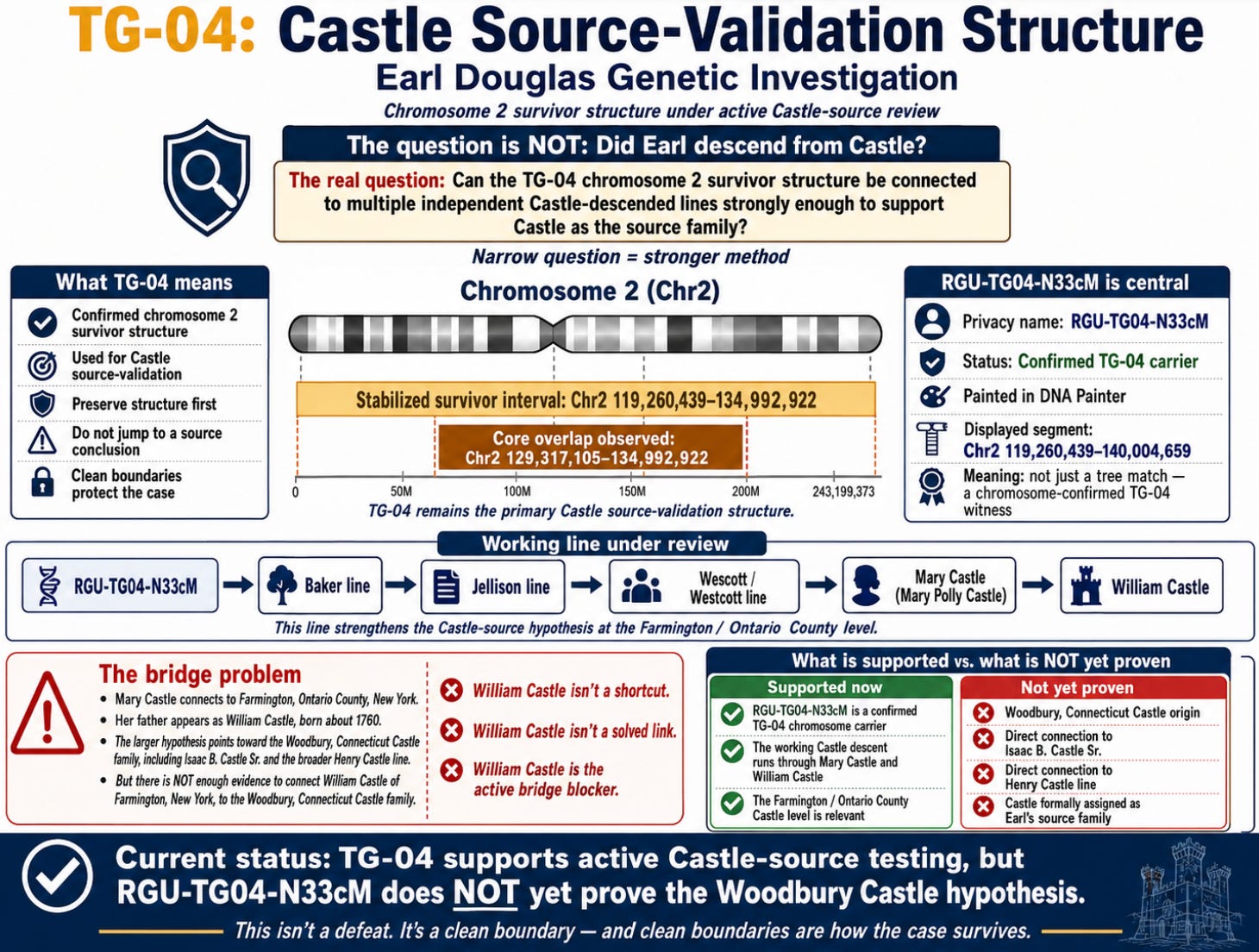
TG-04 remains the primary Castle source-validation structure.
Its stabilized survivor interval is:
Chr2 119,260,439 to 134,992,922.
The core overlap observed is:
Chr2 129,317,105 to 134,992,922.
The working question is not, “Did Earl descend from Castle?”
That is too big.
That is too sloppy.
That is the kind of question that lures you into the weeds with a lantern and leaves you there.
The correct question is narrower:
Can the chromosome 2 survivor structure be connected to multiple independent Castle-descended lines strongly enough to support Castle as the source family?
That is the question.
That is the blade.
RGU is now central to that work.
RGU is already painted in DNA Painter as part of TG-04. The displayed segment is:
Chr2 119,260,439 to 140,004,659.
That means RGU is a confirmed TG-04 chromosome 2 carrier.
That matters because this is not just a person with Castle in a tree. This is a chromosome-confirmed TG-04 witness with a working Castle line under review.
The working tree path runs through:
RGU:
to a Baker line
to a Jellison line
to a Wescott / Westcott line
to Mary Castle
to William Castle.
At first glance, it looks like the kind of line that could open the Castle door.
But genealogy loves a locked door with a fake handle.
The problem is William Castle.
Mary Castle, also appearing as Mary Polly Castle in the working notes, connects to Farmington, Ontario County, New York. Her father appears as William Castle, born about 1760. The larger Castle hypothesis points toward the Woodbury, Connecticut Castle family, including Isaac Castle, 1729–1775, and possibly the broader Henry Castle line.
But there is not enough evidence right now to connect William Castle of Farmington, New York, to the Woodbury, Connecticut Castle family.
That is the bridge problem.
And it is now formally documented as exactly that.
William Castle is not a shortcut.
He is not a solved link.
He is not a permission slip to claim Woodbury.
He is the active bridge blocker.
That means RGU has to be handled with precision.
RGU is a confirmed TG-04 chromosome carrier with a working Castle descent through Mary Castle and William Castle of Farmington, Ontario County, New York.
RGU strengthens the Castle-source hypothesis at the Farmington / Ontario County Castle level.
RGU does not yet prove the Woodbury, Connecticut Castle hypothesis.
That is not a defeat.
That is a clean boundary.
And clean boundaries are how this case survives.
So the Castle signal is getting stronger, but it is not solved.
Two TG-02 lines appear to converge on Isaac Castle of Woodbury, Connecticut.
A third Castle-linked line reaches William Castle of Farmington, New York.
TG-04 gives me a chromosome-confirmed Castle-line witness through RGU-TG04-N33cM.
But the bridge between William Castle of Farmington and the Woodbury Castle family remains unproven.
That is where the work is now.
Not a conclusion.
A pressure point.
The two-track Castle model
The Castle work now has to split into two tracks.
Track A is the Farmington / Ontario County, New York Castle line.
This is the RGU track. It runs through Mary Castle and William Castle. It’s chromosome-relevant because RGU carries TG-04. It’s important. It’s active. It deserves pressure.
Track B is the Woodbury, Connecticut Castle line.
This is the Isaac B. Castle Sr. / Henry Castle candidate zone. It remains a possible source family, but it isn’t proven into the William Castle of Farmington line.
Until the bridge is documented, those tracks stay separate.
Or, I work other matches backward in a family tree and link them to Isaac Castle or his descendant, which I haven’t done yet.
No forced merge.
No internet genealogy duct tape.
No “probably.”
No “close enough.”
The case has had enough fog already.
The next step isn’t to jump to Henry Castle. It’s to document the RGU-TG04-N33cM branch generation by generation and then attack William Castle of Farmington with records.
Land records.
Probate.
Church records.
Tax lists.
Cemetery records.
Local histories.
Migration patterns.
Clustered neighbors.
Anything that can tell us whether William Castle belongs to the Woodbury Castle family, another Castle family, or some separate line entirely.
This is where the work gets less glamorous but more important.
Because if William Castle breaks open, TG-04 changes.
If he doesn’t, Castle stays candidate only.
That’s the deal.
What the map says right now
Here’s the current state of the investigation in plain language.
TG-01 is a confirmed chromosome 6 core, kept separate from TG-03.
TG-03 is a broader chromosome 6 upstream continuity structure, useful but separate.
TG-02 is a confirmed chromosome 3 structure, expanded, painted, and supported by FTDNA AutoSegment evidence.
TG-04 is a confirmed chromosome 2 survivor structure, with Castle source-validation active but not proven.
TG-05 is a confirmed chromosome 20 later-arm structure, MKA supported and maternal-control clean, but source unresolved.
TG-06 is a confirmed chromosome 4 triangulated core, my-kit-anchored, maternally excluded, painted, but source unresolved.
TG-07 is a confirmed chromosome 20 low-arm structure, my-kit-anchored, maternal-control clean, painted, and separate from TG-05.
That’s a lot.
It still doesn’t name Earl’s parents.
But it gives me something I didn’t have before:
A working chromosome map of surviving ancestry.
This map isn’t a conclusion.
It’s a battlefield.
Every confirmed target group is a position gained.
Every source caution is a sandbag against over-claiming.
Every parked file is a trap avoided.
Every “source unresolved” is frustrating, but it’s also honest.
And honest is the only way this case gets solved.
What this phase taught me
This phase changed how I think about the whole project.
I used to think the answer would come from finding the right person.
Now I think the answer may come from refusing to chase people too early.
That sounds backward, but it’s true.
In a normal family history project, people come first. You build the tree. You collect records. You chase names.
In this case, names are dangerous.
Surnames sparkle.
Trees copy each other.
Colonial lines multiply like rabbits in a courthouse basement.
Every family has a patriot, a pioneer, a mystery father, and a pile of unsourced claims waiting to ambush the desperate researcher.
If I chase names too early, I’ll find exactly what I want to find.
That’s the problem.
The chromosome has to lead.
The target group has to justify the tree.
The structure has to earn the labor.
That’s why TG-02 could be parked.
That’s why TG-05 had to be tightened.
That’s why TG-07 had to be kept separate from TG-05.
That’s why RGU-TG04-N33cM matters but doesn’t yet prove Castle.
That’s why William Castle now gets his own bridge problem file instead of being shoved into Woodbury because the story would be prettier that way.
I don’t need a prettier story.
I need a truer one.
Where the investigation goes next
The next major workbench is TG-04 Castle source validation.
That means the RGU branch gets documented generation by generation. The working line to Mary Castle and William Castle has to be separated into record-supported facts, tree-supported claims, and unresolved gaps.
Then William Castle of Farmington becomes the target.
Who was he?
Where was he born?
Who were his parents?
Did he migrate from Connecticut?
Did he appear near known Castle relatives?
Did he leave land, probate, church, tax, or cemetery records?
Was he part of the Woodbury Castle network, or are we looking at a different Castle line entirely?
At the same time, JBE remains important because this witness participates in both TG-02 and TG-04-associated review. KSK and PMC remain part of the Castle validation standard. The associated chromosome 2 persistence environment remains separate from TG-04 unless future evidence proves shared source behavior.
Everything stays disciplined.
Everything stays mapped.
No source ancestor.
No MRCA.
No surname-source.
No parent candidate.
Not yet.
The case went cold, but the chromosomes didn’t
This is the strange thing about DNA.
It doesn’t care that the records failed.
It doesn’t care that a child was moved.
It doesn’t care that names were omitted, changed, guessed, hidden, forgotten, or never written down in the first place.
It just keeps passing fragments forward until, one day, somebody stubborn enough starts putting them back on the wall.
That’s what I’m doing now.
Not solving the case in one glorious strike.
Not announcing Earl’s parents.
Not crowning Castle.
Not pretending a chromosome segment is a family Bible.
Just building the map.
One target group at a time.
One chromosome at a time.
One caution at a time.
The work is slow, but it’s no longer blind.
TG-02 is preserved.
TG-05 is confirmed.
TG-06 is painted.
TG-07 is newly discovered, confirmed, and mapped.
TG-04 is back on the table. Castle remains candidate only. And William Castle is still standing in the doorway like a long-dead man who knows exactly how much trouble he’s causing.
That’s where the case sits tonight.
The map is getting sharper.
The walls are getting closer.
And somewhere inside these surviving fragments, Earl’s story is still waiting to be named.
Not guessed.
Not wished into place.
Named when the evidence can carry the weight.
Thanks for reading.
Recent Posts


Works Cited
International Society of Genetic Genealogy Wiki. “Triangulation.” Accessed July 14, 2026. https://isogg.org/wiki/Triangulation.
GEDmatch. “How to Triangulate Your Matches.” Accessed July 14, 2026. https://www.gedmatch.com/education/how-to-triangulate-your-matches/.
GEDmatch. “What Is a DNA Triangulation with a Crossmatch?” Accessed July 14, 2026. https://www.gedmatch.com/education/what-is-a-dna-triangulation-with-a-crossmatch/.
DNA Painter. “Help and Advice on How to Use This Site.” Accessed July 14, 2026. https://dnapainter.com/help.
DNA Painter. “How Do You Use DNA Painter to Map Your Chromosomes?” Accessed July 14, 2026. https://dnapainter.com/help/how-to-use.
FamilyTreeDNA. “Chromosome Browser Introduction.” Accessed July 14, 2026. https://help.familytreedna.com/hc/en-us/articles/360004591836-Chromosome-Browser-Introduction.
FamilyTreeDNA. “Chromosome Browser Guide.” Accessed July 14, 2026. https://help.familytreedna.com/hc/en-us/articles/360004684575-Chromosome-Browser-Guide.
FamilyTreeDNA. “Family Finder Matches Introduction.” Accessed July 14, 2026. https://help.familytreedna.com/hc/en-us/articles/360004683815-Family-Finder-Matches-Introduction.
Board for Certification of Genealogists. “Ethics and Standards.” Accessed July 14, 2026. https://bcgcertification.org/ethics-standards.
Board for Certification of Genealogists. “Ten-Minute Methodology: What Is ‘Reasonably Exhaustive’ Research?” September 3, 2015. https://bcgcertification.org/ten-minute-methodology-what-is-reasonably-exhaustive-research.
FamilySearch Wiki. “Genealogical Proof Standard.” Last modified April 30, 2023. https://www.familysearch.org/en/wiki/Genealogical_Proof_Standard.
National Genealogical Society. “The Genealogical Proof Standard.” Accessed July 14, 2026. https://www.ngsgenealogy.org/going-to-the-next-level/understanding-genealogical-proof/.
FamilySearch Wiki. “Ontario County, New York Genealogy.” Last modified March 9, 2026. https://www.familysearch.org/en/wiki/Ontario_County%2C_New_York_Genealogy.
FamilySearch Wiki. “Farmington, Ontario County, New York Genealogy.” Last modified January 15, 2026. https://www.familysearch.org/en/wiki/Farmington%2C_Ontario_County%2C_New_York_Genealogy.
Ontario County Clerk. “Online Record Search.” Accessed July 14, 2026. https://www.ontariocountyny.gov/146/Online-Record-Search.
FamilySearch Wiki. “Woodbury, Litchfield County, Connecticut Genealogy.” Accessed July 14, 2026. https://www.familysearch.org/en/wiki/Woodbury%2C_Litchfield_County%2C_Connecticut_Genealogy.
FamilySearch Wiki. “Litchfield County, Connecticut Genealogy.” Accessed July 14, 2026. https://www.familysearch.org/en/wiki/Litchfield_County%2C_Connecticut_Genealogy.
FamilySearch Wiki. “Connecticut, United States Genealogy.” Accessed July 14, 2026. https://www.familysearch.org/en/wiki/Connecticut%2C_United_States_Genealogy.
Douglas, Nate. “TG-02 DNA Painter Log.” Earl Douglas Genetic Investigation. Private research file, updated July 2026.
Douglas, Nate. “TG-05 Chromosome 20 Core Tightening Report.” Earl Douglas Genetic Investigation. Private research file, updated July 2026.
Douglas, Nate. “TG-07 Chr20 Low-Arm Triangulated Structure Log.” Earl Douglas Genetic Investigation. Private research file, updated July 2026.
Douglas, Nate. “TG-04 Castle Source Validation Notes: RGU-TG04-N33cM.” Earl Douglas Genetic Investigation. Private research file, updated July 2026.
GEDmatch. One-to-one autosomal comparison reports for relevant Earl Douglas Genetic Investigation kits. Private research files. Accessed July 2026.
FamilyTreeDNA. AutoSegment cluster output for TG-02. Earl Douglas Genetic Investigation. Private research file, downloaded July 2026.
DNA Painter. Chromosome map for Earl Douglas Genetic Investigation. Private working profile. Accessed July 2026.