

Foundlings in Demand
What “orphan” really meant in 1902 Duluth

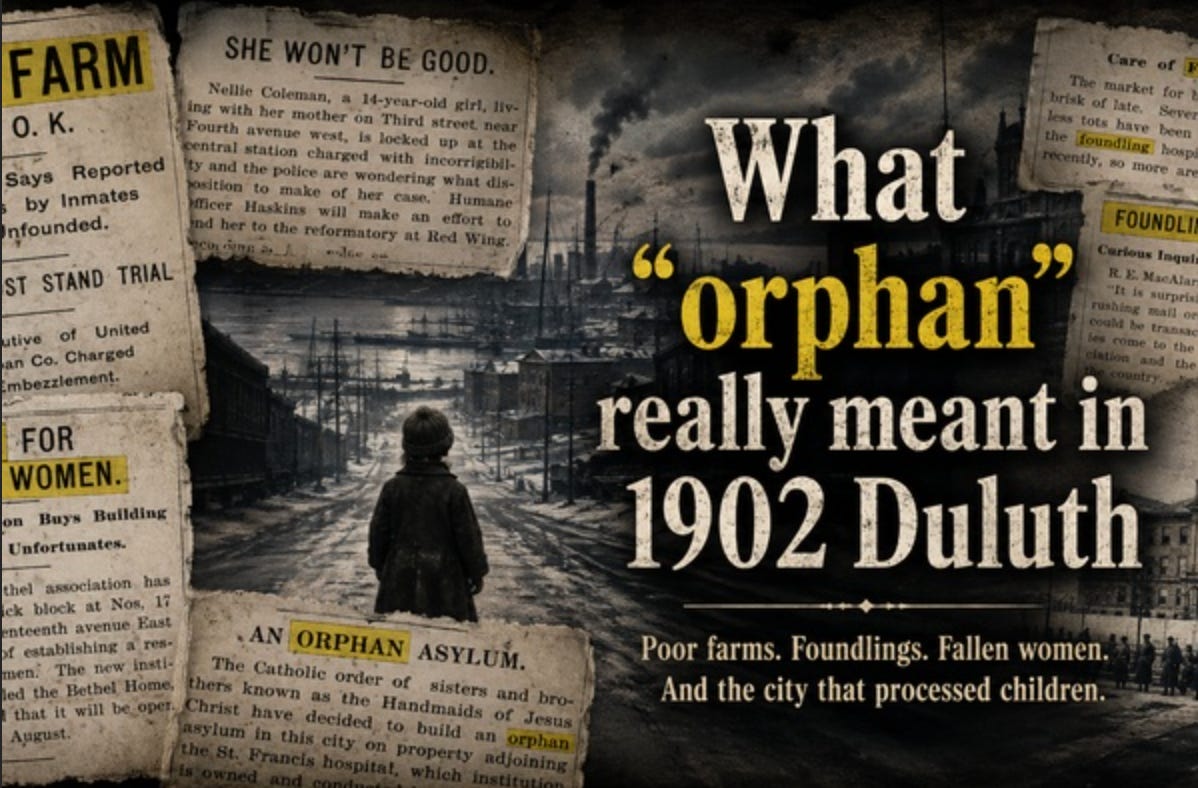
In Duluth, a child could disappear without ever leaving town.
No kidnapping.
No ransom note.
No dramatic vanishing act.
No detective with a cigarette and a bad marriage staring at Lake Superior like it owed him answers.
Just a name moved from one system to another.
Poor farm.
Rescue home.
Orphan asylum.
Foundling hospital.
Reformatory.
A county office.
A hospital.
A household that took him in.
A census taker standing at the door, pencil in hand, needing one word for a story nobody in the room cared to explain.
Orphan.
Foundling.
Adopted son.
No parents listed.
Those words look harmless until you put them back in the city that produced them.
A child became a case. A woman became a warning. A baby became an inquiry. A family collapse became a newspaper paragraph wedged between meat advertisements and courthouse gossip.
That was the world waiting for Earl Mack Douglas when he was born in Duluth, Minnesota, in January 1896.
Duluth’s geography mattered. Its timing mattered. Its relationship with the Industrial Revolution mattered. The city’s success and its failures came from the same place.
This was a town barely grafted onto a 1,500-foot cliff of volcanic rock, sitting at the western edge of Lake Superior like a fist clenched around water, timber, iron, rail, and ambition.
Duluth in the 1890s was not a quiet northern postcard.
It was docks, railroads, lumber, iron, smoke, boarding houses, hospitals, churches, saloons, poverty, immigrant labor, and brutal weather. People arrived faster than the city could absorb them.
By 1902, Duluth was not a sleepy harbor town wrapped in pine smoke and civic virtue.
It was an industrial throat.
It swallowed men, freight, timber, ore, immigrants, widows, children, and women with nowhere else to go.
The city moved cargo.
It moved trains.
It moved timber.
It moved high-grade hematite ore.
It moved bodies through work, poverty, charity, jail, hospital, and the grave.
But it did not always preserve names.
That is where Earl’s story begins.
He was born in Duluth in January 1896. Six years later, according to Julia Lewis’s later affidavit, she took him “from a home” in Duluth.
That phrase sounds soft.
A home.
Warm. Safe. Christian. Domestic. Maybe even kind.
But in 1902 Duluth, “home” could mean almost anything.
A children’s home.
A women’s home.
A rescue home.
A charitable institution.
A religious institution.
A temporary holding place.
A county-connected arrangement.
A place where a boy waited while adults decided what to label him and where to put him.
Sometimes “home” was not a home at all.
Sometimes it was the room where the record began to erase you.
For a small child, that was not paperwork.
That was weather inside the body.
The kind of fear learned before language. The kind of abandonment that settles into the nervous system, the blood, the sleep. The way a child listens for footsteps in the hallway, waiting for someone who may never come back.
That is why “orphan” is not enough.
It sounds like an answer.
But it is usually the beginning of the problem.
Orphaning Was Not an Accident
You can come to your own conclusions about orphanhood in nineteenth-century America, but I do not think it can be explained by sentiment alone.
This was not just a sad age with sad children.
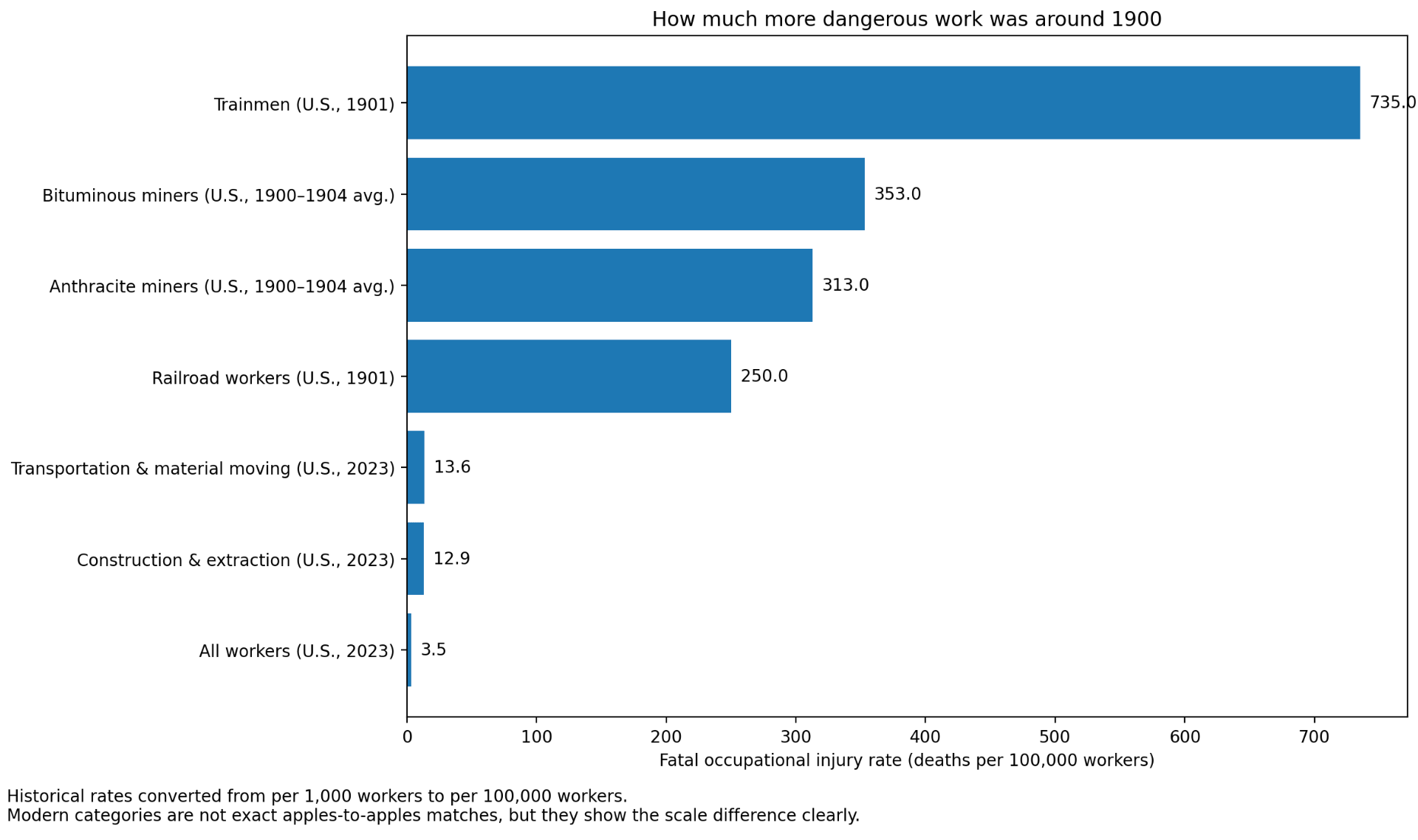
This was a country feeding the Industrial Revolution a never-ending supply of bodies.
Men’s bodies.
Women’s bodies.
Children’s bodies.
Bodies for railroads. Bodies for docks. Bodies for mines. Bodies for mills. Bodies for lumber camps. Bodies for factories. Bodies for construction sites. Bodies for the work nobody rich wanted to do and nobody poor could afford to refuse.
Industry did not simply build America.
It broke the American family in a profound way.
Orphanhood was one of its products.
That is the side of American history nobody wants to talk about: the collapsing American family. The one where men died at work, women were blamed for survival, children were sorted into institutions, and poverty got renamed as moral failure.
That is where the orphan story lives.
In wreckage.
The newspapers called the wreckage “orphans,” “foundlings,” “dependent children,” “fallen women,” “incorrigible girls,” “poor farm inmates,” “friendless women,” and “unfortunates.”
But those words were not explanations.
They were cleanup labels.
They were what the system called people after the damage had already been done.
A man died in a rail yard, and the railroad kept moving. His wife became charity. His children became dependents. His family became a case.
A father was crushed at a construction site, and the family became a charity problem.
A laborer lost his health, his wages, or his mind, and the county called the household dependent.
A young woman gave birth outside marriage, and the city called her fallen.
A girl ran the streets because the adults around her had failed or vanished, and the police called her incorrigible.
A baby entered an institution, and the newspaper called it a foundling.
The machine always had a name ready.
Orphan. Foundling. Dependent. Fallen. Incorrigible.
It rarely had mercy.
In the nineteenth-century United States, orphaning was not only caused by workplace tragedy. It was caused by instability. A child could be orphaned by disease, poverty, abandonment, incarceration, childbirth, industrial accident, social shame, or a father who left home looking for work and never came back.
Sometimes the father was dead.
Sometimes he was drunk.
Sometimes he was in prison.
Sometimes he was nameless.
Sometimes he was alive but economically useless in a world where a man’s worth was measured by whether his body could still earn a living.
That is the brutal truth underneath the orphan record.
The child welfare system was not just rescuing children from broken homes.
It was absorbing children from an economy that broke homes and called the wreckage charity.
Duluth Kept Moving. Families Paid the Cost.
Duluth makes this impossible to ignore.
At the turn of the century, it was a port city, a railroad city, a lumber city, an iron ore city, a city of weather and docks and boarding houses and men chasing wages through dangerous work.
It was built by movement.
Ships moving out.
Trains moving in.
Ore moving through.
Workers moving wherever the next job appeared.
Immigrants passing through the port from all over the world.
And when men moved like freight, families paid the cost.
A father could be killed.
A mother could be left with nothing.
A child could be placed in a home.
A girl could be sent to a reformatory.
A woman could be routed toward a rescue house.
A family could collapse into the poor farm, the orphan asylum, the county office, the church society, the hospital, or a newspaper column.
That is what the Duluth clippings show.
They show the machinery around the child.
The poor farm.
The Women’s Relief Society.
The orphan asylum.
The rescue home for “fallen women.”
The girl labeled “incorrigible.”
The foundlings described as being “in demand.”
The baby market.
The informal adoption.
The adult foundling returning years later, running his finger down the page, trying to find out who he really was.
That is the part that matters most.
The city did not always preserve the child’s origin.
It preserved the institution.
It preserved the category.
It preserved the moral judgment.
It preserved the respectable people who managed the crisis.
But the parent?
The father?
The mother?
The bloodline?
The story?
Those could disappear.
So when I look at Earl Mack Douglas, I do not see a simple orphan story.
I see the product of an age.
Earl was born into a city where fathers were consumed by work, mothers were punished by morality, and children moved through institutions before they were old enough to defend their own names.
Later, Earl himself died young the way so many men of that world died.
On the job.
Under the machine.
At work.
That matters.
Because Earl was not only a child who may have been orphaned by industrial America.
He became one of the fathers industrial America killed.
That is the circle.
The same world that could take a father from a child could later take Earl from his own children.
The same system that processed dependent children depended on men like him to keep moving the freight, the ore, the timber, the passengers, the money, the empire.
And when those men died, the institutions kept going.
The railroad kept going.
The port kept going.
The city kept going.
The paperwork kept going.
The family took the wound.
That is what orphaning meant in industrial America.
It was not just the absence of parents.
It was the presence of a machine powerful enough to make parents disappear.
The Poor Farm Was Not Somewhere Else
In March 1895, the Duluth News Tribune reported that ladies of the Women’s Relief Society had begun visiting the county poor farm. Their stated purpose was to learn the system and become acquainted with those needing assistance.
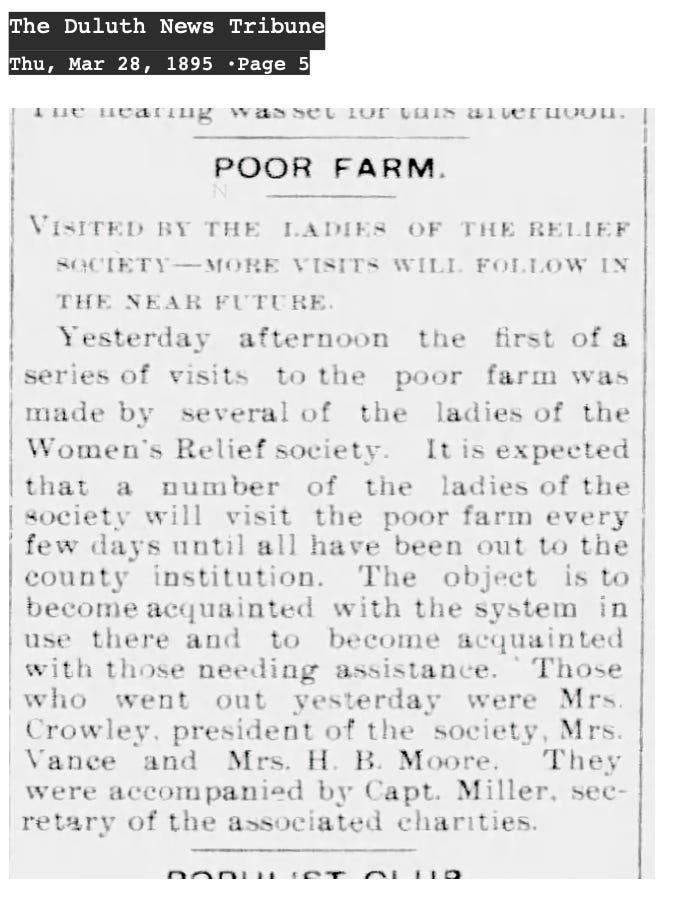
That sounds clean on the surface.
Respectable women visiting the unfortunate.
Charity with gloves on.
But poor farms were not abstract places. They were where a county sent people it did not know what else to do with.
The elderly.
The sick.
The disabled.
The abandoned.
The poor.
The inconvenient.
The children of broken households could orbit that same world, even if they were later moved into another category.
A June 1895 feature described Duluth’s poor farm in detail: the buildings, the inmates, the food, the rooms, the sick, the “infirmary wanted,” and the demand for better facilities. It was presented almost like a civic tour. A place of order, care, need, and decay all at once.
That is the first thing to understand.
Duluth did not have one system for human collapse.
It had a network.
A woman might touch the relief society. A sick man might end up at the poor farm. A child might be sent to an orphan asylum. A young girl might be threatened with Red Wing. A pregnant woman might be pushed toward a rescue home. A baby might become a foundling.
Different doors.
Same building, morally speaking.
“She Won’t Be Good”
On July 23, 1896, the Duluth News Tribune ran a small article with a headline that does the violence before the story even starts:
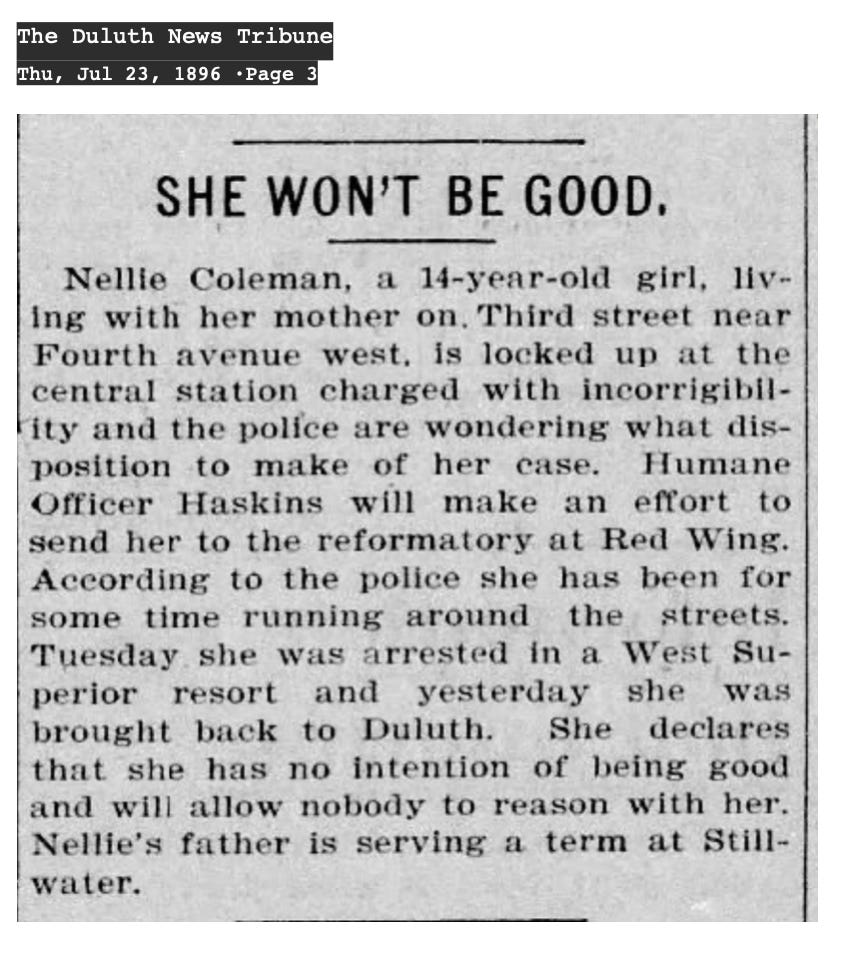
SHE WON’T BE GOOD.
The subject was a 14-year-old girl named Nellie Coleman.
She was locked up at the central station, charged with “incorrigibility.” The police were wondering what disposition to make of her case. A humane officer would try to send her to the reformatory at Red Wing.
According to the article, she had been “running around the streets.” She had been arrested in a West Superior resort. She declared she had no intention of being good.
Then the article drops the real context at the end:
Her father was serving a term at Stillwater Prison.
That last sentence changes everything.
This was not just a “bad girl” story. This was a child inside a family structure already damaged by incarceration, poverty, absence, and public shame.
But the newspaper did not lead with that.
It led with judgment.
“She won’t be good.”
That is how the system talked about children when it did not want to talk about what had happened to them first.
A girl was not described as endangered.
She was incorrigible.
A child was not described as wounded.
She was a problem.
And once a child became a problem, the next question was not “what does she need?”
The next question was “where do we send her?”
That matters because the same logic surrounded dependent children, orphaned children, abandoned children, and foundlings.
The label came first.
The life came later, if anyone bothered to look.
The City Was Building the Machinery
In August 1896, the same year Earl was born, the Duluth News Tribune reported plans for an orphan asylum on property adjoining St. Francis Hospital.
That detail matters.
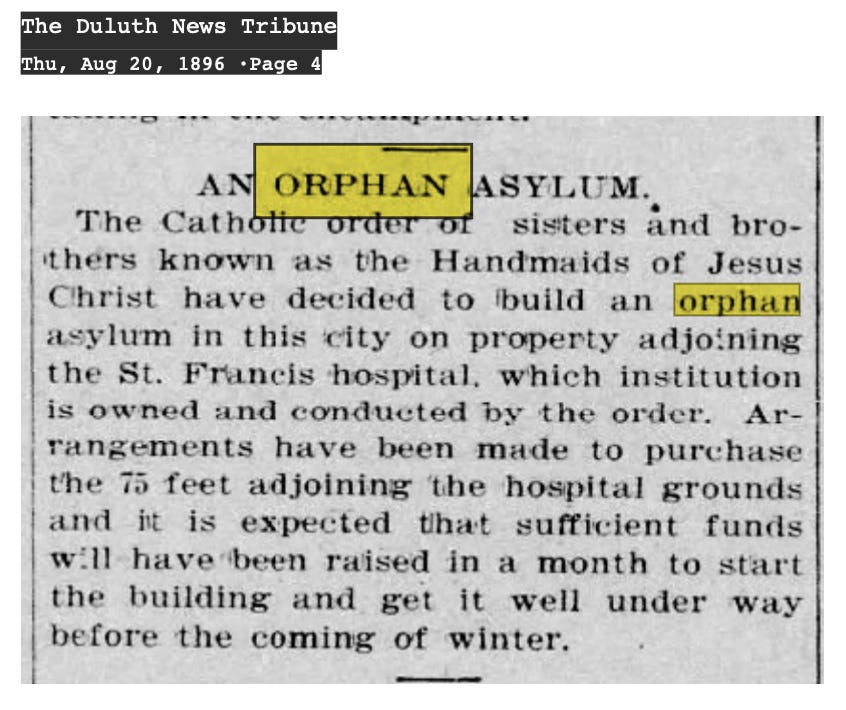
The asylum was not imagined off in the woods somewhere, separate from real life. It was being built beside a hospital. Birth, sickness, death, infancy, religion, charity, abandonment, and moral rescue were all standing in the same hallway.
This was not an accident.
This was architecture.
Duluth was becoming a city that needed places to put children whose families had collapsed, disappeared, died, or become inconvenient.
The city was not just growing.
It was sorting.
Women went one direction.
Children another.
The sick another.
The poor another.
The criminal another.
The morally condemned another.
But they were all part of the same map.
A girl could be labeled incorrigible.
A pregnant woman could be labeled fallen.
A child could be labeled orphaned.
A baby could be labeled foundling.
The labels changed.
The machine stayed the same.
The Fallen Woman and the Child Left Behind
By 1900, Duluth was debating another doorway into the same machinery: the rescue home.
The phrase of the day was “fallen women.”
It is a filthy phrase dressed up as morality.
It did not mean a woman had tripped.
It meant society had already judged her.
Unmarried mother.
Sexually exploited girl.
Poor woman.
Pregnant woman.
Prostituted woman.
Abandoned woman.
Woman who had been used by a man and then blamed for the evidence.
The Duluth News Tribune reported that Mrs. John Callahan of Bethel believed Duluth needed a rescue home because it was becoming a big city. The article described women arriving from elsewhere, girls imposed upon, young women entering hospitals to give birth, then leaving town while their children were left behind.
Read that again.
A girl comes to Duluth.
She gives birth.
She leaves.
The child remains.
That is not a morality tale.
That is a custody event.
That is a genealogical crime scene.
The article even gave an example: a 16-year-old girl attached to a man about 50 years old. She became a mother. The fatherless child was taken to a children’s home in St. Paul.
Sixteen.
A man about fifty.
A baby.
A children’s home.
And the vocabulary of the time still knew how to make the girl the moral problem.
That is the poison in these records.
They do not just tell us what happened.
They tell us who the public was trained to blame.
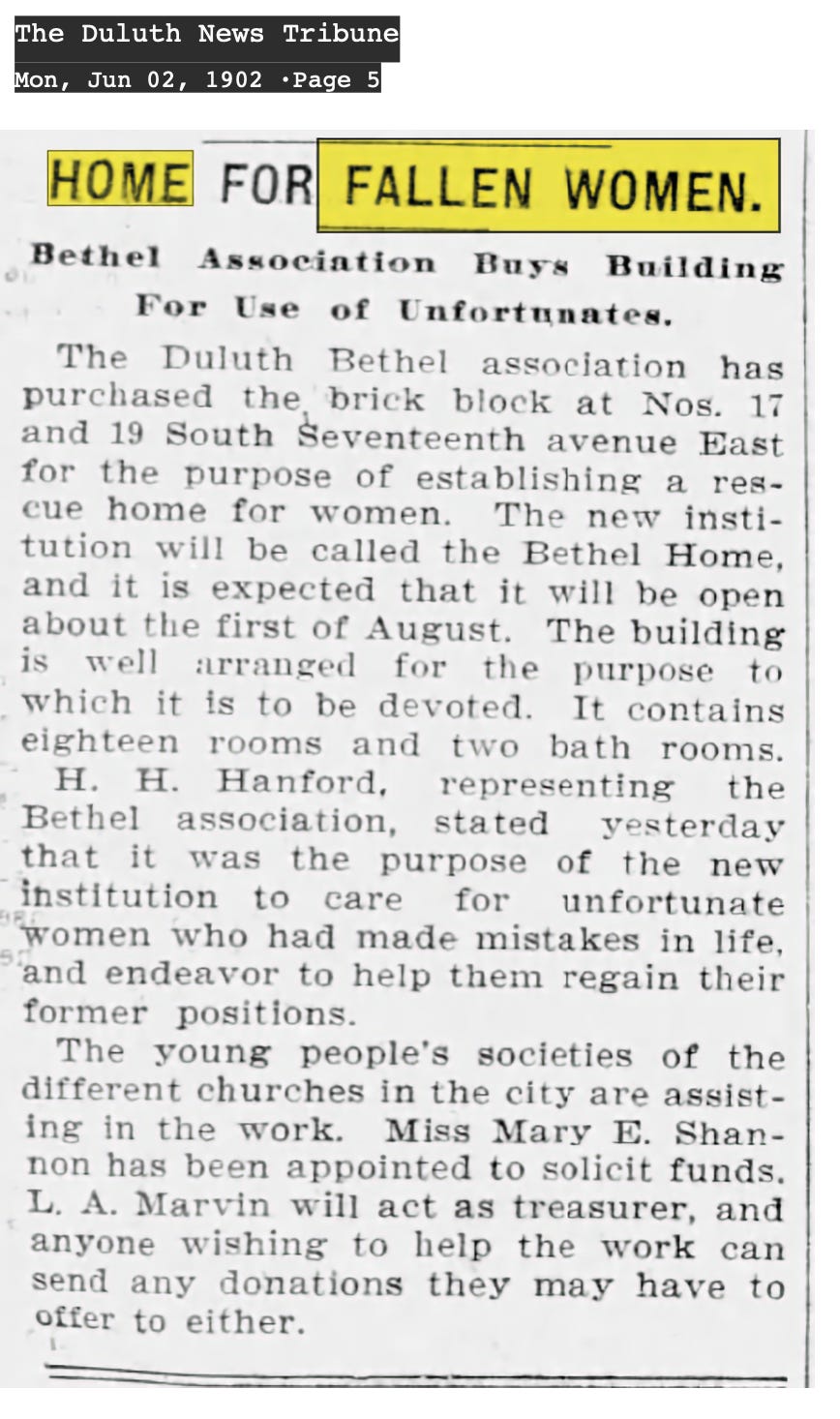
By June 1902, Duluth’s Bethel Association had purchased a building at 17 and 19 South Seventeenth Avenue East to establish a rescue home for women. It would be called the Bethel Home.
The article said the institution would care for “unfortunate women who had made mistakes in life” and help them regain their former positions.
Unfortunate women.
Made mistakes.
Regain their former positions.
This was the language of rescue, but also the language of blame.
A pregnant unmarried woman was not just unsupported.
She was fallen.
A girl exploited by an older man was not just harmed.
She had made a mistake.
A mother without money was not just desperate.
She was a moral problem.
And the child born from that crisis entered the world already carrying the weight of adult shame.
That matters for Earl.
Because if his mother entered one of these systems, or any system like it, her name may not have been preserved as a mother.
She may have been preserved as a case.
Or not preserved at all.
The Market for Babies
Then comes the sentence that should stop every genealogist cold.
In February 1901, the Duluth News Tribune printed an item under the heading “Care of Foundlings.”
It began with this:
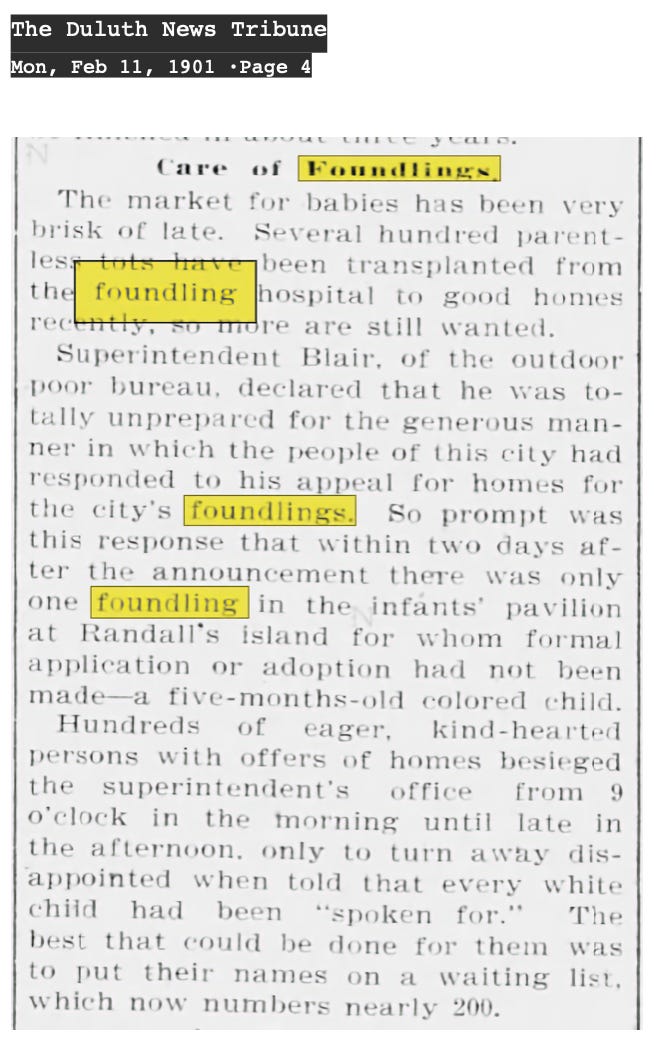
“The market for babies has been very brisk of late.”
The market.
For babies.
That was not my phrase.
That was theirs.
That was the public language.
That was the respectable print.
That was the country telling on itself.
The article reported that several hundred parentless children had recently been moved from a foundling hospital into homes, and that more were still wanted.
Then it got worse.
Only one child remained without an application.
A five-month-old Black child.
The article said hundreds of eager, kind-hearted people had come forward offering homes, only to be disappointed when told every white child had already been “spoken for.”
Spoken for.
Not rescued.
Not protected.
Not restored.
Spoken for.
The racial logic was right there in the open.
White children were wanted.
A Black child was left.
Even charity had a color line.
So no, the orphan story was not just about kindness. That is the clean version. The greeting-card version. The version with soft light and bad history.
The real system was soaked in preference.
Race.
Class.
Age.
Sex.
Religion.
Legitimacy.
Paperwork.
Adult desire.
Institutional convenience.
Some children were chosen.
Some were tolerated.
Some were left behind.
And every once in a while, the newspaper forgot to hide the teeth.
Foundlings in Demand
That is a hell of a phrase.
Not children in crisis.
Not babies needing families.
Foundlings in demand.
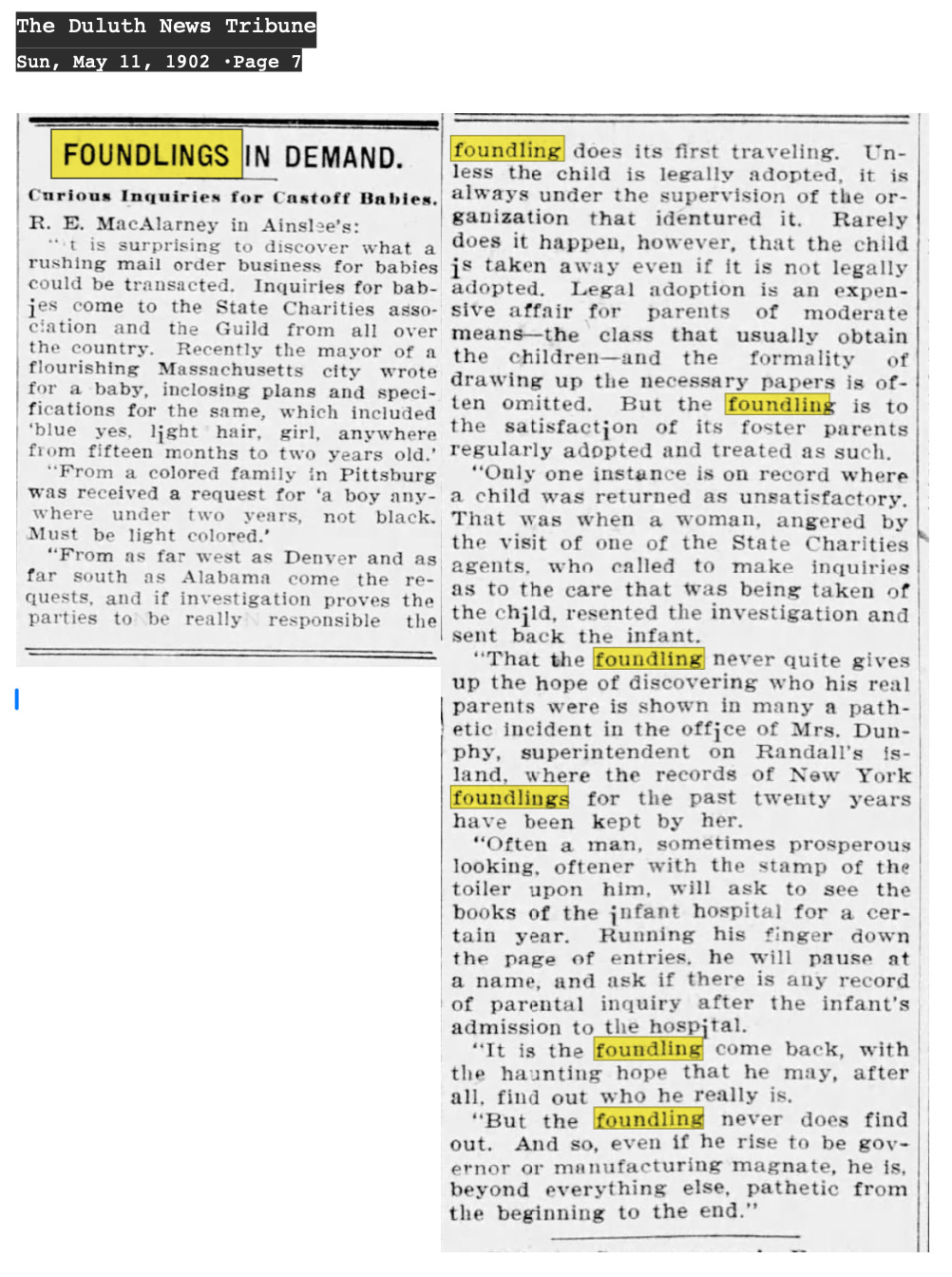
The article described inquiries for babies arriving from around the country. Some requests were specific enough to make your skin crawl.
A girl between fifteen months and two years old.
Blue eyes.
Light hair.
A boy under two.
Not Black.
Must be light colored.
That was child placement written like an order slip.
Age.
Sex.
Hair.
Eyes.
Race.
A baby became a set of specifications.
This is where genealogy has to stop pretending the past was gentle.
People were not only adopting children.
They were selecting them.
And the system was helping them do it.
The same article explained that unless the child was legally adopted, the child remained under the supervision of the organization that had indentured it. Legal adoption was expensive for families of moderate means, so the paperwork was often skipped.
That one detail is a bomb.
It means a child could be placed into a household, raised under a new name, treated as family, recorded as adopted, and still leave no clean legal adoption file.
It means “adopted son” in a census does not always point to a courthouse record.
It means a child could belong socially, but not legally.
It means a child could be moved through charity, fosterage, indenture, informal adoption, or private arrangement, leaving behind a record trail full of holes.
That is exactly the kind of world where a boy like Earl Douglas could disappear into another family without his origin following him.
Not because no one knew.
Because the system did not always preserve what mattered most.
The Foundling Comes Back
The most haunting part of the 1902 foundling article is not the demand for babies.
It is what happens years later.
The child grows up.
The wound does not.
The article described adult foundlings returning to the books, trying to discover who their real parents were.
A man comes back.
Maybe prosperous.
Maybe worn down by labor.
Maybe respectable now.
Maybe important.
He asks to see the records for the year he was admitted.
He runs his finger down the page.
He pauses at a name.
He asks whether anyone ever came looking for him.
That image is brutal because it is so quiet.
No courtroom.
No priest.
No mother weeping in the doorway.
Just a grown man and a book.
A man old enough to have built a life, still looking for the first missing fact.
Who was I?
Who left me?
Who looked for me?
Who knew my name before the system changed it?
That is the real wound.
Not just abandonment.
Erasure.
The article understood the tragedy, but not the cure. It could imagine the foundling becoming successful, even prominent, and still remaining pathetic from beginning to end because the first question was never answered.
That was the old world speaking.
It could describe the ache.
It could not repair the theft.
Why “Orphan” Is Not Enough
So when a record says orphan, be careful.
When a record says foundling, be careful.
When a record says adopted son, be careful.
Those words are not always facts.
Sometimes they are administrative translations.
A child might have had two dead parents.
Or one dead parent.
Or a living mother too poor to keep him.
Or a father in prison.
Or a father dead in the machinery.
Or a mother forced into a rescue home.
Or a birth outside marriage.
Or a temporary placement that hardened into permanence.
Or a family member who took him in without papers.
Or a charity that placed him out and moved on.
Or an institution that kept better track of discipline than blood.
That is the problem at the center of Earl Douglas.
He was born in Duluth in 1896.
By 1902, Julia Lewis said she took him “from a home” in Duluth.
Later records call him an adopted son, a foundling, and a man whose parents were not living.
But those are labels.
They are not the whole story.
They are chalk marks left after the body was moved.
Duluth Kept the Machinery. Earl Lost the Origin.
The poor farm showed how the county managed poverty.
The Women’s Relief Society showed respectable charity watching the wreckage.
The Nellie Coleman article showed how quickly a child could become a moral problem.
The orphan asylum showed Duluth building institutions for children without secure families.
The rescue home articles showed unmarried women and exploited girls being routed through moral reform.
The foundling articles showed babies being requested, selected, placed, supervised, indentured, adopted, or not adopted.
Together, they do not merely describe Duluth.
They expose it.
They show a city building a network for human emergencies while speaking about women and children in the language of shame, discipline, demand, and disposal.
This was not one institution.
It was an ecosystem.
Somewhere inside that ecosystem, Earl Douglas passed through a door.
Maybe as an orphan.
Maybe as a foundling.
Maybe as the child of a dead father and a desperate mother.
Maybe as the son of someone whose name was recorded once and then buried.
Maybe as a boy who was not abandoned so much as processed.
That is the word I keep coming back to.
Processed.
The city did not have to hate a child to erase him.
It only had to handle him.
It only had to move him from one category to another.
It only had to call him what the paperwork needed him to be.
Orphan.
Foundling.
Adopted son.
No parents listed.
And more than a century later, here I am doing exactly what that foundling article described.
Coming back to the books.
Running my finger down the page.
Looking for the name.
Trying to find out who he really was.


Bibliography
“An Orphan Asylum.” Duluth News Tribune (Duluth, MN), August 20, 1896. Newspapers.com.
“Care of Foundlings.” Duluth News Tribune (Duluth, MN), February 11, 1901. Newspapers.com.
“Foundlings in Demand: Curious Inquiries for Castoff Babies.” Duluth News Tribune (Duluth, MN), May 11, 1902. Newspapers.com.
“Home for Fallen Women.” Duluth News Tribune (Duluth, MN), June 2, 1902. Newspapers.com.
“Need Rescue Home.” Duluth News Tribune (Duluth, MN), May 20, 1900. Newspapers.com.
“Over the Hills: That Is the Way to Reach the Poor Farm Near Duluth.” Duluth News Tribune (Duluth, MN), June 23, 1895. Newspapers.com.
“Poor Farm: Visited by the Ladies of the Relief Society.” Duluth News Tribune (Duluth, MN), March 28, 1895. Newspapers.com.
“Poor Farm All O.K.” Duluth News Tribune (Duluth, MN), May 11, 1895. Newspapers.com.
“She Won’t Be Good.” Duluth News Tribune (Duluth, MN), July 23, 1896. Newspapers.com.
Minnesota Adjutant General’s Office. Military bonus application file for Earl Mack Douglas, warrant no. 73717, including affidavit of Julia L. Lewis / Lewis E. Jones, July 27, 1920. Minnesota state bonus records.
United States Census Bureau. Twelfth Census of the United States, 1900. Washington, DC: National Archives and Records Administration.
United States Census Bureau. Minnesota State Census, 1905. Minnesota Historical Society / FamilySearch.
United States Census Bureau. Thirteenth Census of the United States, 1910. Washington, DC: National Archives and Records Administration.
United States Census Bureau. Fourteenth Census of the United States, 1920. Washington, DC: National Archives and Records Administration.
United States Census Bureau. Fifteenth Census of the United States, 1930. Washington, DC: National Archives and Records Administration.
United States Department of Labor, Bureau of Labor Statistics. National Census of Fatal Occupational Injuries in 2023. Washington, DC: Bureau of Labor Statistics, 2024.
United States Bureau of the Census. Historical Statistics of the United States, 1789–1945. Washington, DC: Government Printing Office, 1949.
Interstate Commerce Commission. Statistics of Railways in the United States. Washington, DC: Government Printing Office. Various annual reports.
Martin, Albro. Railroads Triumphant: The Growth, Rejection, and Rebirth of a Vital American Force. New York: Oxford University Press, 1992.
Mohl, Raymond A. Poverty in New York, 1783–1825. New York: Oxford University Press, 1971.
Hacsi, Timothy A. Second Home: Orphan Asylums and Poor Families in America. Cambridge, MA: Harvard University Press, 1997.