

The Moment a Ghost Population Started Getting a Name
For 130 years, Earl Douglas had no documented biological family. Then strangers, chromosomes, and a forgotten Irish migration path begins telling the story.

A Note Before We Begin
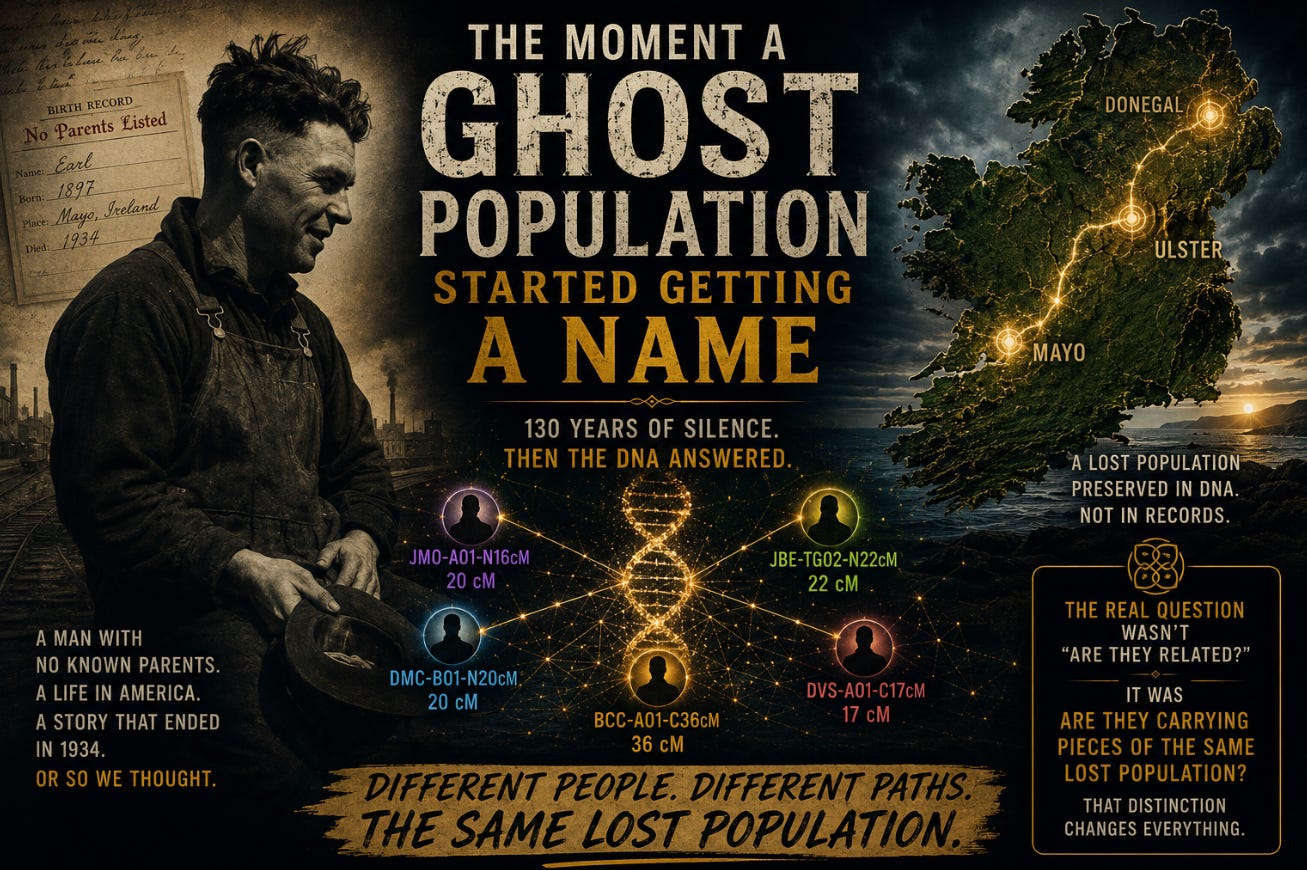
After 130 years of silence, Earl Douglas’s ghost population started getting a name.
Before I get into the details of where this investigation has gone over the last several days, I want to explain something that may be helpful to other researchers, genealogists, or anyone staring at a brick wall that refuses to move.
Because some brick walls do not just sit there.
They bite back.
Anyone who has worked on a difficult genealogy problem knows exactly what I mean.
There comes a point where the easy records are gone.
The census does not answer the question.
The birth certificate does not magically appear.
The family story falls apart.
Eventually, researchers are left with a few choices:
Accept the unknown.
Make assumptions.
Build a theory around weak evidence.
Or walk away.
I understand why people do.
This kind of work can become exhausting.
Earl Douglas has been that kind of case.
No parents listed.
No clean family structure.
No simple paper trail waiting to be discovered.
Just fragments.
And fragments are dangerous if you start forcing them to become answers.
So before I explain the DNA, chromosomes, triangulation groups, and migration patterns, I think it is worth explaining the process behind the process.
Because getting here was not clean.
One of the biggest lessons I have learned is that organization is not optional.
It is evidence protection.
I probably would have been much further along in this if I understood that earlier.
I have always struggled with organization.
Part of that is just how my brain works. I am dyslexic and have dealt with adult ADHD, which means keeping thousands of tiny details organized is not exactly my natural strength.
And this kind of research is unforgiving.
One wrong assumption.
One mislabeled DNA match.
One undocumented conclusion.
One forgotten source.
That small mistake can create drift.
And once drift enters the investigation, everything built afterward becomes questionable.
I have restarted parts of this project more times than I would like to admit.
Not because the evidence disappeared.
Because the structure holding the evidence was not strong enough.
My biggest piece of advice:
Document everything.
Then document why you documented it.
Then document what you are going to do about it.
Document what you did about it.
Repeat.
Audit.
That sounds excessive.
But when you are working with hundreds of DNA matches, chromosome segments, family trees, locations, surnames, and competing theories, memory is not evidence.
You need a system.
I currently use markdown-based platforms like Obsidian and Notion because they allow me to build an actual research environment instead of a pile of disconnected notes.
Every match has a place.
Every conclusion has a source.
Every change leaves a trail.
I keep daily progress reports because six months from now I need to know not only what I believed, but why I believed it.
Genealogy is not just finding information.
It is maintaining the chain of custody of your own reasoning.
I also want to address something that comes up frequently:
Artificial intelligence.
Yes, I use AI.
But probably not in the way people assume.
AI did not solve Earl.
AI did not discover a hidden record.
AI did not replace research.
What it has done is help me manage the enormous amount of information created by this investigation.
I use AI like a research assistant.
It helps organize data, build tables, compare information, format reports, review patterns, and challenge my thinking.
But there is one rule:
The evidence is still my responsibility.
Every conclusion has to return to the original source.
Every DNA match has to be verified.
Every record has to be checked.
Every theory has to survive being challenged.
If AI produces something, I treat it the same way I would treat an unsourced family tree.
Interesting.
Potentially useful.
Not evidence until verified.
I still write my Substack articles myself.
These are my words.
My story.
My family.
I use AI for things like organization, editing, transitions, research management, and visual concepts. AI-generated images are reviewed and approved before use.
But AI cannot replace the human responsibility behind the work.
Especially with a project like this.
There are living DNA matches involved.
There are private family histories involved.
There are real people behind every chromosome segment.
My biggest fear has never been failing to solve Earl’s story.
My biggest fear is getting it wrong.
Publishing something inaccurate.
Misrepresenting someone.
Turning another person’s family history into a theory instead of evidence.
I owe my readers better than that.
I owe Earl better than that.
The strange thing about AI is that it can make some parts faster while making the responsibility even greater.
It can organize faster.
It can summarize faster.
It can connect ideas faster.
But the slow work remains.
Reviewing.
Checking.
Documenting.
Protecting privacy.
Making sure the foundation is solid.
Because genealogy is not about collecting names.
It is about reconstructing lives.
And if I am going to bring forgotten people back into history, I have a responsibility to do it carefully.
My biggest motivation for doing this is the reader.
My hope is that sharing the process, including the mistakes, rebuilding, and lessons learned, eventually helps another person facing a mystery they thought could never be solved.
Now, with that said, here is what happened when the evidence finally started moving.
The Moment a Ghost Population Started Getting a Name
For most of this investigation, I have been chasing something that technically did not have a name.
That sounds strange.
How do you search for a family when you do not know the family?
How do you build a tree when the trunk is missing?
That has always been the central problem with Earl Douglas.
Most genealogists work from a known person backward.
A parent.
A grandparent.
A surname.
A hometown.
Something.
I did not have that.
I had a man born in Duluth, Minnesota in 1896 who repeatedly appeared in records without biological parents.
I had his adopted family.
I had documents, but many of those documents created more questions than answers.
I had silence exactly where answers should have existed.
A ghost population is not a group of imaginary people.
They were real.
They lived.
They married.
They crossed oceans.
They had children.
They left descendants.
They simply disappeared from Earl Douglas’s paper trail.
My job has been to find the population history forgot to write down.
So the investigation had to work differently.
Instead of asking:
“Who were Earl Mack Douglas’s biological parents?”
Or:
“Who was Earl’s biological family?”
The question had to change to fit the evidence:
“What group of people keeps surviving?”
Because if the records lost their names, maybe the DNA could still find their relationships.
The first breakthrough was not a name.
It was a chromosome.
When Chromosomes Stop Being Random
Earlier in the investigation, a small segment of DNA survived repeated testing between three independent people.
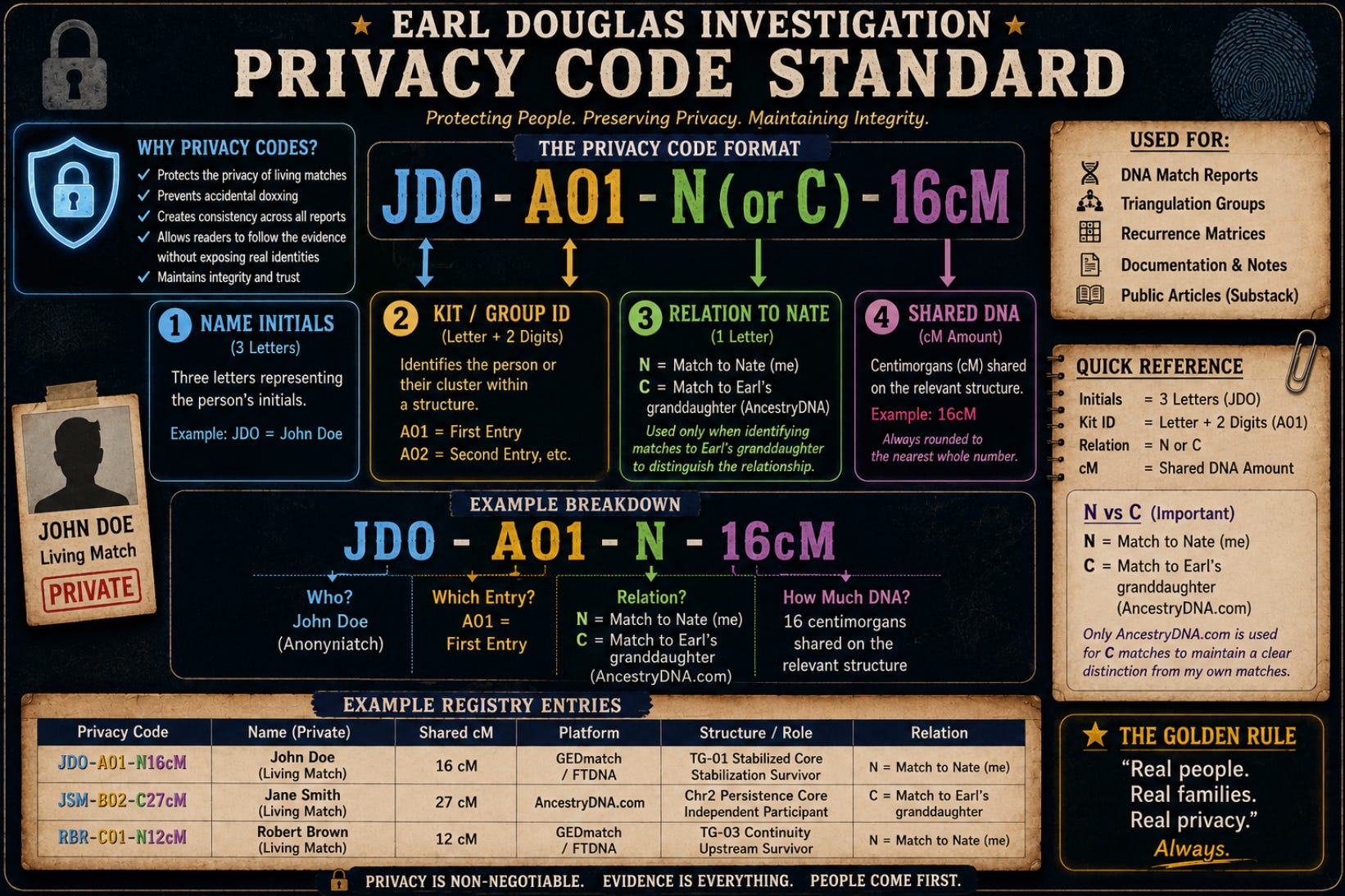
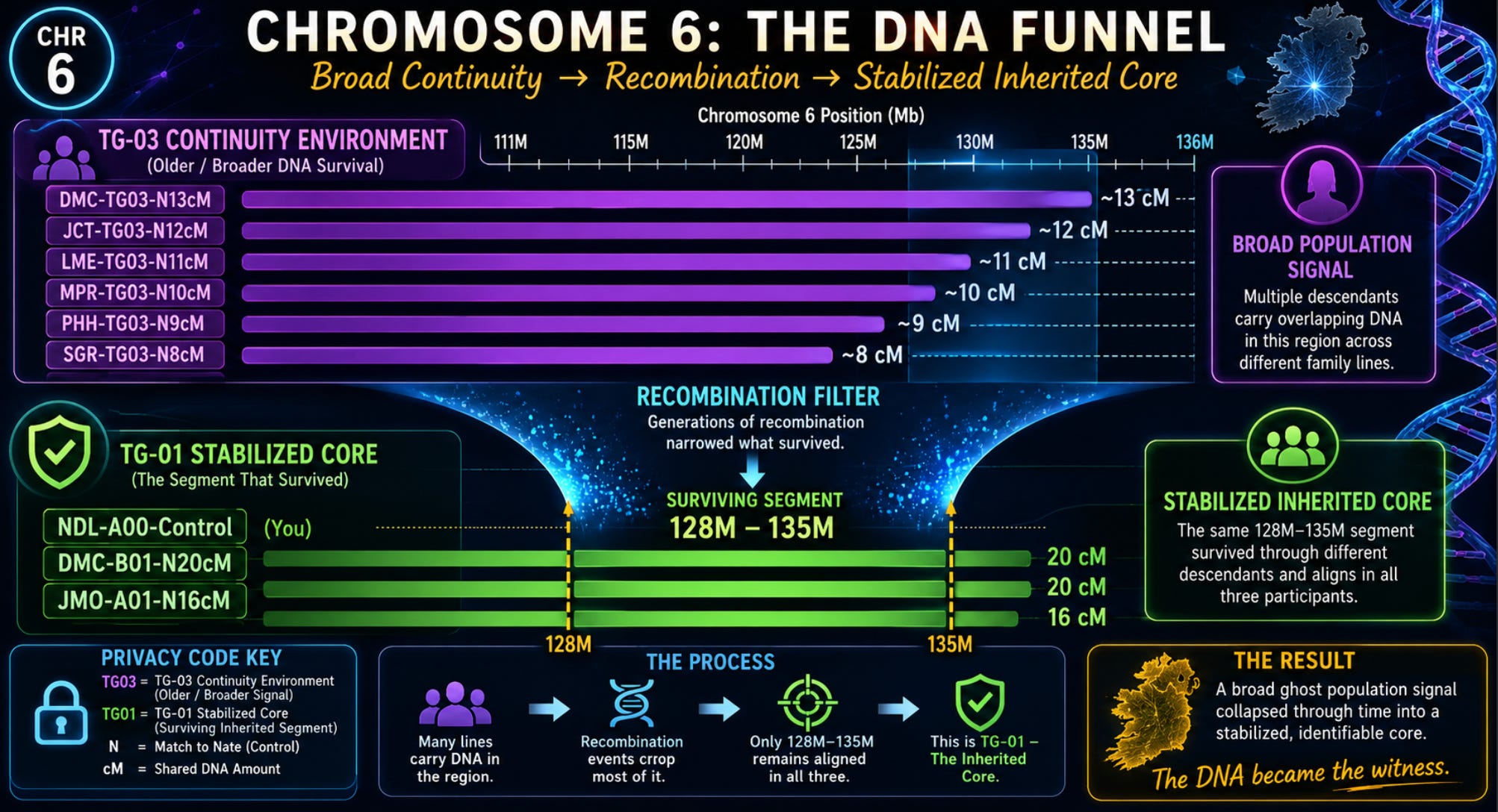
Before introducing living DNA matches, I replace identities with privacy codes. The codes allow the evidence trail to be followed while protecting the privacy of real people connected to this investigation.
The first confirmed structure involved:
NDL-A00-Control (me)
JMO-A01-N16cM
DMC-B01-N20cM
The segment was not important simply because it existed.
Everyone has DNA matches.
Thousands of them.
The important question is:
Does the evidence survive pressure?
Does it survive when compared against other people?
Does it survive when thresholds change?
Does it survive when new evidence is introduced?
Or does the original theory disappear?
Many candidate connections fall apart during that process.
This one did not.
That surviving structure became TG-01.
A triangulation group.
A small piece of inherited DNA shared between multiple people that points backward toward a common ancestor.
For the first time, Earl’s missing family was no longer completely invisible.
A piece of them was still here.
Every generation adds static. Time breaks the signal apart. But every once in a while, a fragment survives long enough to remind us someone was here.
Then I Tried to Break It
Good research is not trying to prove yourself right.
It is trying to prove yourself wrong.
That became the next phase.
The question was not:
“How can I make TG-01 fit?”
The question was:
“What would make TG-01 fail?”
So the structure was tested again.
Thresholds changed.
Segments were reviewed.
DNA Painter was audited.
Matches were reclassified.
Every assumption was challenged.
And something important happened.
It survived.
The chromosome 6 structure stayed intact.
The evidence did not collapse.
That matters.
Because in genetic genealogy, survival is evidence.
A Pattern Started Repeating
Then something unexpected happened.
Chromosome 6 was not alone.
Another structure appeared.
Chromosome 2.
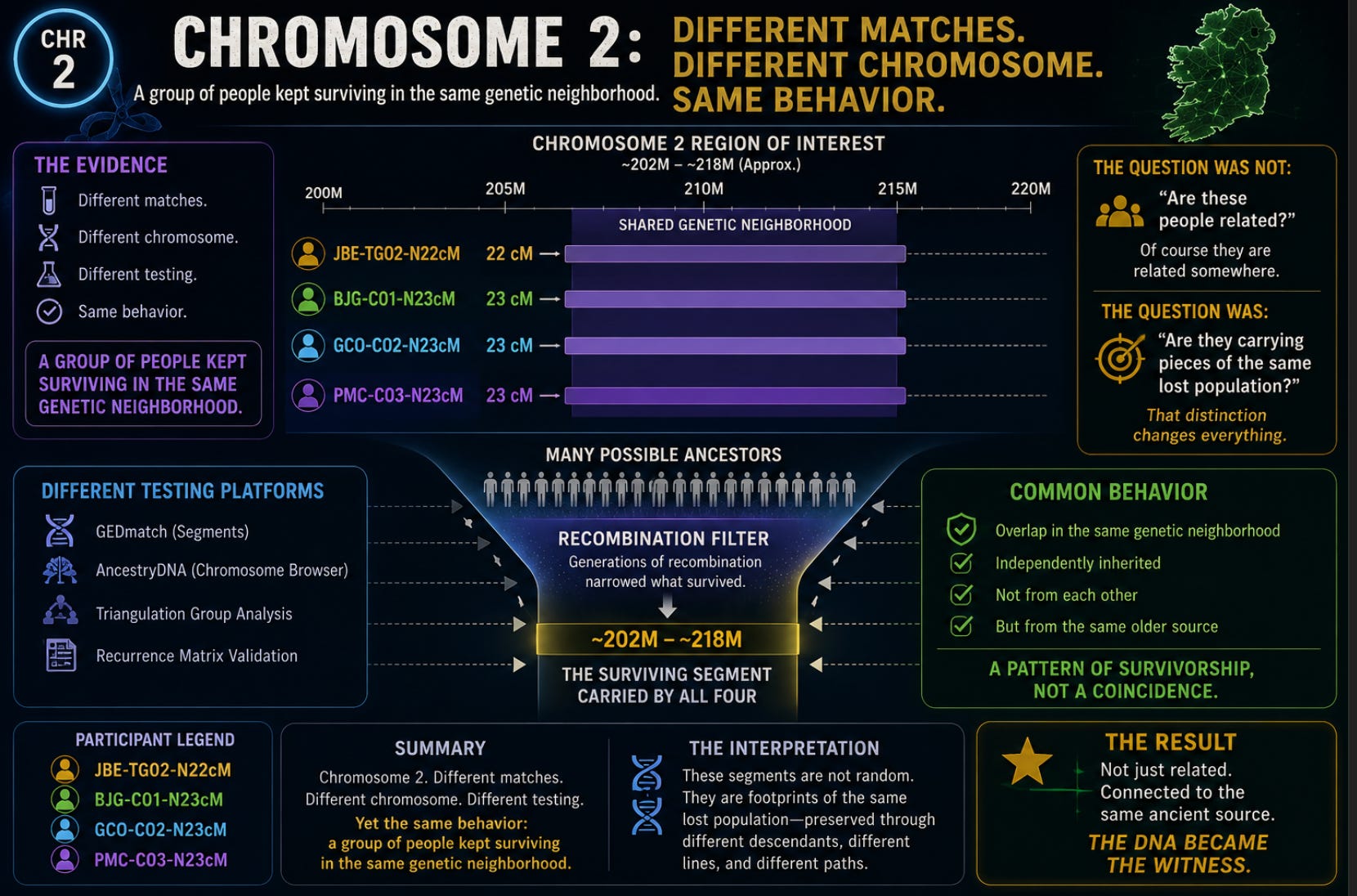
Different matches.
Different chromosome.
Different testing.
But the same behavior.
A separate group of people kept surviving in the same genetic neighborhood.
JBE-TG02-N22cM
BJG-C01-N23cM
GCO-C02-N23cM
PMC-C03-N23cM
That changed the question again.
The question was no longer:
“Are these people related?”
Of course they are related somewhere.
That is how DNA works.
The better question became:
“Are they carrying pieces of the same lost population?”
Because a single DNA match can be interesting.
A repeated pattern becomes something else.
That distinction changes everything.
The First Person Who Crossed Between Worlds
Then came JBE-TG02-N22cM.
This match became important because it stopped behaving like an isolated DNA connection.
It started showing up repeatedly.
Chromosome 2.
Chromosome 3.
Chromosome 20 (still developing).
Different locations.
Different tests.
Different evidence streams.
Same privacy-coded participant.
In forensic reconstruction, that matters.
A single appearance can be coincidence.
Repeated appearances create a pattern.
JBE-TG02-N22cM became what I classify as a convergence candidate.
A person who appears across multiple independent evidence structures.
Not proof.
Not an answer.
A direction.
A reason to keep testing.
Because after 130 years of no direction, even knowing where to look next matters.
The Strangers Started Connecting
Then the investigation shifted again.
The chromosomes started connecting with people.
Real people.
Real families.
Real places.
Separate pieces of evidence that had been floating independently started appearing together.
BCC-A01-C36cM.
RCL-A05-C30cM.
JMD-A03-C24cM.
JVT-A02-N66cM.
JEN-A04-N51cM.
DVS-A01-C17cM.
These were not people selected because they fit a theory.
They emerged because the DNA kept bringing them back.
And then something else started repeating.
Geography.
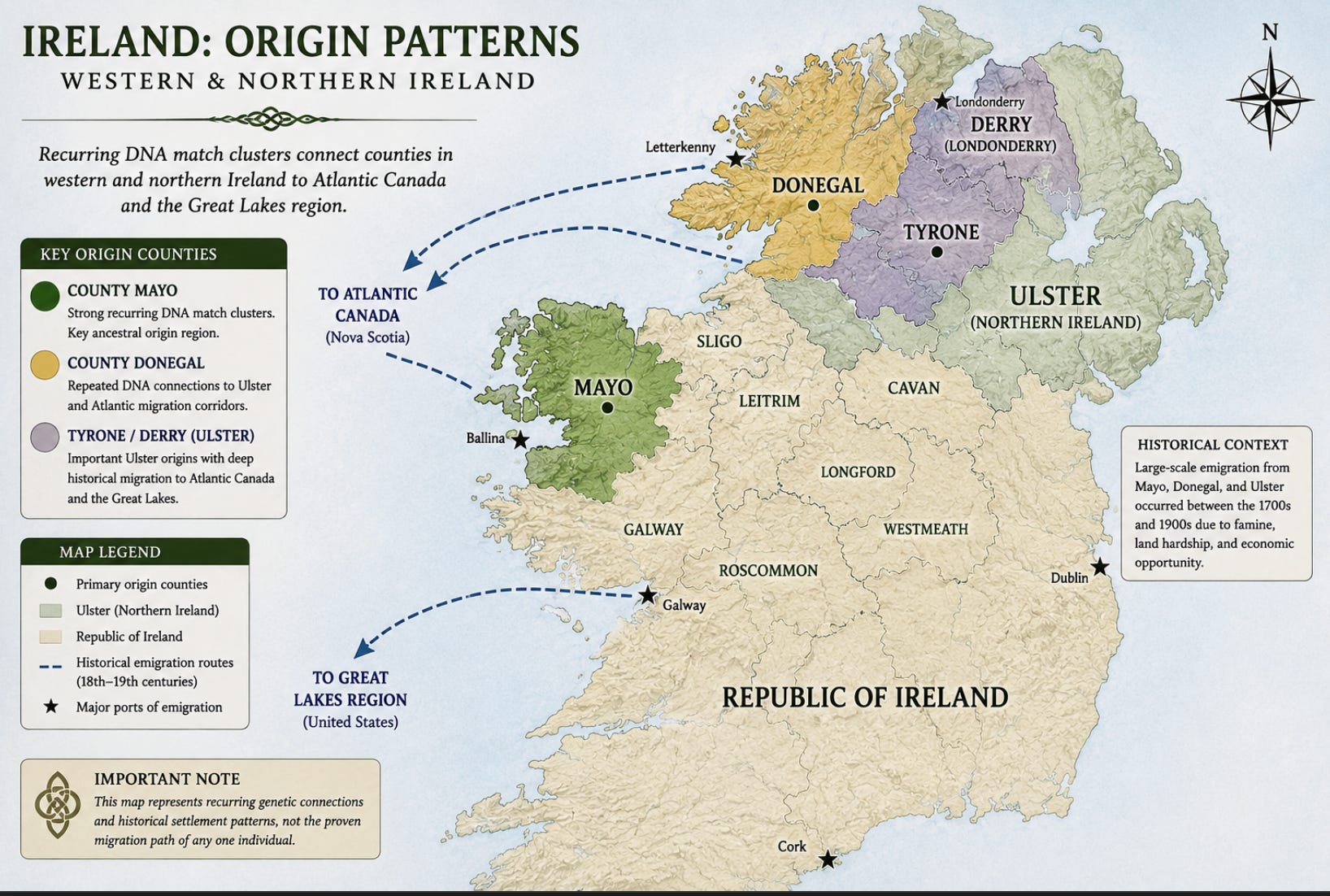
County Mayo.
Donegal.
Tyrone.
Ulster.
The same migration corridors.
The same historical pathways.
The same genetic communities appearing again and again.
The ghost population finally started developing edges.
Earl’s Missing Family Is Becoming Visible
This is the strange thing about DNA:
A person can disappear from paper.
A courthouse can lose a record.
A name can be forgotten.
A child can be separated from a family.
But DNA doesn’t preserve stories.
It preserves relationships.
For 130 years, Earl Douglas existed without a documented biological family.
But pieces of that family kept moving forward.
Through strangers.
Through chromosome recombination.
Through descendants who had no idea they were carrying fragments of the answer.
The investigation isn’t finished.
There is no final ancestor yet.
There is no dramatic reveal.
And that’s important.
Because real genealogy usually does not work like television drama.
The answer does’t simply appear.
It accumulates.
One record.
One segment.
One match.
One surviving piece of evidence at a time.
I still don’t know Earl Douglas’s biological parents.
But I know something today that I didn’t know before.
They belonged somewhere.
They came from one specific community.
They left descendants.
And after more than a century of silence, that community is no longer completely invisible.
Earl’s ghost population is finally getting named.
More Articles


Research Notes & Sources
Wisconsin State Census, 1905, Washburn County, Wisconsin, Minong Township, household of Julia L. Lewis, entry for Earl Douglas. Wisconsin Historical Society, Madison, Wisconsin.
United States Census Bureau. Thirteenth Census of the United States, 1910. Washburn County, Wisconsin, Minong Township, population schedule, household of Julia L. Lewis, entry for Earl Douglas. National Archives and Records Administration, Washington, D.C.
Earl M. Douglas, World War I Draft Registration Card, 5 June 1917, Washburn County, Wisconsin. World War I Selective Service System Draft Registration Cards, 1917–1918. National Archives and Records Administration.
Minnesota Soldiers Bonus Board. Military Service Bonus Application File for Earl M. Douglas. Warrant no. 73717. Minnesota Historical Society, St. Paul, Minnesota.
Earl M. Douglas military service documentation, Company F, 6th Division Motor Supply Train, United States Army, 1918–1919. World War I service records and supporting military documentation.
North Dakota Department of Health. Death record for Earl M. Douglas, 6 June 1934, Drake, McHenry County, North Dakota.
GEDmatch. One-to-One Autosomal DNA Comparison Tool. Chromosome segment analysis conducted using Build 37 coordinates. Earl M. Douglas Genetic Investigation private research files, Nate Douglas, 2026.
GEDmatch. Autosomal Segment Search and Triangulation Tools. Triangulation group S-A-CHR6-01; chromosome 6 segment comparison and reciprocal validation testing. Earl M. Douglas Genetic Investigation private research files, Nate Douglas, 2026.
Douglas, Nate. TG01 Validation Report: Chromosome 6 Triangulation Analysis. Version 3.0. Earl M. Douglas Genetic Investigation. Unpublished research report, 2026.
Douglas, Nate. Chr6 Master Segment Registry. Earl M. Douglas Genetic Investigation. Private chromosome mapping database, 2026.
Douglas, Nate. Master Recurrence Matrix: Cross-Chromosome Survivorship Analysis. Earl M. Douglas Genetic Investigation. Private research database, 2026.
Douglas, Nate. Cross Structure Recurrence Log. Earl M. Douglas Genetic Investigation. Private research database, 2026.
DNA Painter. Chromosome Mapping Tool. Chromosome painting and segment visualization analysis performed as part of the Earl M. Douglas Genetic Investigation, 2026.
AncestryDNA. Shared match clustering, genetic network reconstruction, and descendant comparison analysis. Private DNA results reviewed through authorized descendant-managed accounts, 2026.
Mayo North Family History Centre. The Family of James Scanlon, Shanaghy, Kilmoremoy, Co. Mayo. Enniscoe, Castlehill, Ballina, County Mayo, Ireland, March 2016.
Douglas, Nate. Mayo Corridor Registry: Geographic Convergence and Recurring Surname Analysis. Earl M. Douglas Genetic Investigation. Private research notes, 2026.
Douglas, Nate. Privacy Code Registry: Living DNA Match Protection Standard. Earl M. Douglas Genetic Investigation. Internal documentation protocol, 2026.
Research Privacy Statement
Living DNA participants are anonymized throughout this investigation using internal privacy codes. Names, identifying information, and private genetic data are withheld unless previously public or shared with permission.
Privacy codes preserve:
evidence tracking,
chromosome comparison integrity,
research reproducibility,
and participant confidentiality.