

The Anchor Tree
Why Earl Douglas’s parents aren’t missing. They’re hiding in plain sight.

For most of my life, Earl Douglas existed in the records as a man with no parents.
No names.
No origin story.
Just a birth, a life, and a clean white void where lineage should be.
That blank space isn’t neutral. It’s loud. It hums. It dares you to fill it with something easy.
Genealogy wants you to start at the person and build outward. Names first. Trees second. DNA only if you’re desperate and out of options.
I stopped doing that.
I didn’t stop because it was hard.
I stopped because it was wrong.
This is what happens when you build a family tree from the DNA inward instead.
What I built, and what I refused to build
This is not a traditional family tree.
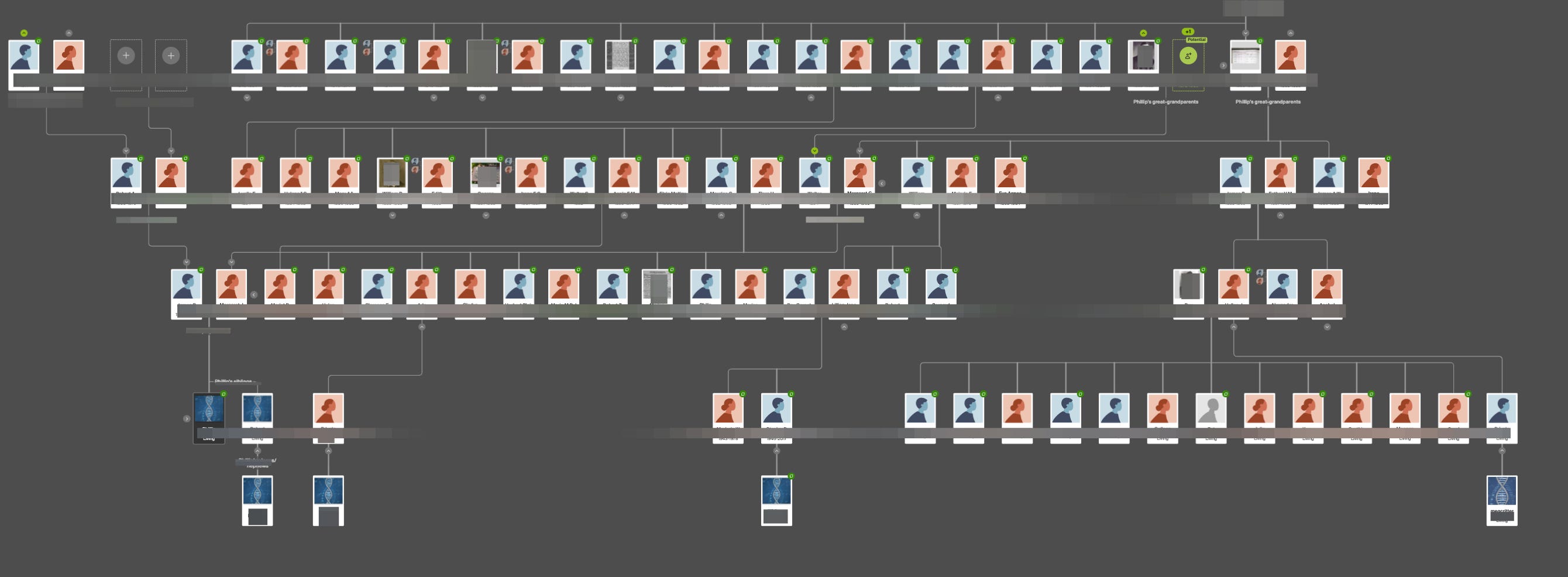
It’s an anchor-based genetic constraint model built using AncestryDNA. It doesn’t exist to tell a comforting story. It exists to draw a line around the truth and say, it’s in here somewhere.
Not who Earl Douglas’s parents were.
Where they had to come from.
This tree doesn’t solve the mystery.
It locks the doors and shuts the exits.
The anchors
I worked from three genetically independent descendants of Earl Douglas. From working with Jenimhm, we have known for years, our confirmed triangulation with 1C1R falls into Earl’s lines. Which parental line is not yet confirmed.
(1C1R). Earl’s biological granddaughter. Closest generation. Loudest signal. The backbone.
JTV. Father of jenimhm. A recurring County Mayo Irish cluster that wouldn’t stop showing up.
JAM. Independent descendant. The control. The skeptic in the room.
These aren’t characters. They’re load-bearing walls.
Colleen’s DNA carries the weight.
The others exist to test it. To push back. To say, prove it again.
The method, stripped bare
Here’s what I actually did. No mysticism. No vibes.
With access to 1C1R matches using AncestryDNA, I:
Examined the match lists of the anchor descendants
Identified overlapping matches between them
Prioritized matches with public family trees
Rebuilt those trees three to four generations back by hand
Kept only the people and branches that showed up again and again
If it didn’t repeat, it didn’t matter.
I didn’t care how pretty the story was.
I didn’t care how old the surname sounded.
I didn’t care how badly I wanted it to be true.
That’s the rule.
One appearance is an accident.
Repetition is evidence.
The scale of the thing
This wasn’t a hobby exercise. This was a grind.
What came out the other side:
1,733 individuals
666 family units
Over 3,000 documented life events with geographic data
And it’s still incomplete on purpose.
This tree doesn’t exist to be finished.
It exists to make lying to yourself harder.
This system used matches as small as 9 cM, but only after the tree was already constrained. On their own, small segments are noise. Inside a repeatable pattern across independent anchors, they become confirmation. These segments didn’t create branches. They validated that the branches already in place weren’t coincidences.
Why anchors matter or how people fool themselves
One tester is how genealogical myths are born.
One match list. One loud cousin. One surname that feels right. Suddenly the story writes itself and nobody checks the exits.
Multiple independent descendants stop that cold.
Anchors prevent three classic failures:
Letting one person’s match list hijack the narrative
Confusing population DNA with family DNA
Letting surnames lead instead of evidence
In this model, a pattern only survives if:
It appears across more than one anchor, and
It survives independent reconstruction
When all three anchors keep pointing to the same names and places, that’s not coincidence.
That’s gravity.
The surnames that wouldn’t die
Once the tree was locked down, I counted surnames across all 1,733 individuals. These are individual people, not family groups. No padding. No creative accounting.
Here’s who kept showing up no matter how hard I tried to ignore them:
McKay / MacKay: 124
Douglas: 70
Hall: 61
Short: 37
Freeman: 32
Gaughan: 31
Bates: 25
Brown: 22
Morrison: 21
Miller: 19
Clarke: 19
This is not a tidy origin myth.
It’s Irish and Scottish surnames colliding in ports, camps, rail lines, and work crews long before Minnesota ever enters the picture.
That ruins a lot of comfortable theories.
Good.
The map tells on them
When I plotted every birth, marriage, and death, the geography didn’t sprawl.
It narrowed.
Not a scatter.
A corridor.
Where people actually lived:
Canada, Nova Scotia and Ontario: 521 events
Minnesota: 290
Ireland, mostly County Mayo: 209
Scotland: 166
California: 129
Utah: 1
Ireland and Scotland sit upstream like fingerprints on the weapon.
Canada acts as the middleman. The bridge. The laundering point.
Minnesota shows up later, crowded, loud, already mixed.
The West comes last, as fallout.
If this were chaos, the map would explode.
It doesn’t. It tightens.
The corridor
Lay it all together and the path is unmistakable:
Connacht, County Mayo, and Western Scotland
Atlantic Canada, Nova Scotia and Ontario
The Upper Midwest, especially Minnesota
Later westward drift, mostly California
These are labor routes. Timber. Rail. Mining. Ports. Men moving because work demanded it.
And here’s the part that matters most:
Irish and Scottish lines converge before Minnesota.
Which means Minnesota isn’t the source.
It’s the collection point.
Earl Douglas’s parents didn’t start there.
They arrived already carrying history.
What this tree proves and what it refuses to lie about
Established beyond reasonable doubt:
Earl’s ancestry lives inside a narrow, repeatable corridor
A finite set of surnames keeps resurfacing across independent lines
The same families reappear through different anchors, over and over
Not claimed. Not yet. Not carelessly:
Named biological parents
A single ancestral couple
That restraint isn’t weakness. It’s discipline.
This tree exists to tell you where to dig.
Not what to carve in stone.
The quiet truth about the data
Here’s the part most people bury in footnotes.
AncestryDNA is the only platform where I have direct access to 1C1R match data for Earl Douglas’s biological granddaughter, Colleen.
That means:
The core structure of this tree reflects Colleen’s DNA
Surnames, branches, and geography come from her match list
Other anchors exist to challenge and confirm, not to drive
Any future work that uses data outside her matches will be labeled. Loudly.
Because pretending otherwise is how bad genealogy happens.
And here’s the quiet twist.
This work isn’t just about Earl anymore.
It’s about what survives when you accept limits instead of inventing certainty.
What happens next: when the tree meets the chromosomes
So far, this work has lived at the match-list level. Overlap. Repetition. Pressure points.
That was deliberate.
You don’t start with chromosomes. You earn the right to look at them.
Now the tree gets handed off to a different kind of evidence.
From names to segments
A match list tells you who might belong.
A chromosome browser tells you what was actually inherited.
That’s the difference between coincidence and custody.
The next phase takes the constrained tree and asks a harder question:
Do these people share the same physical piece of DNA, or are they just standing near each other in the crowd?
This is where platforms like GEDmatch matter.
Why GEDmatch changes the rules
AncestryDNA is where the structure was built. That’s where the match lists live, where overlap reveals itself, and where independent anchors can be compared at scale. It’s ideal for identifying repetition: the same surnames, the same families, the same places resurfacing across different descendants. That’s how the framework takes shape.
GEDmatch is where the structure gets stress-tested. It strips away surnames, trees, and assumptions and forces the model to answer a simpler question: do these people share the same physical segment of DNA, or not? On GEDmatch, relationships stop being implied and start being measurable. Segments either line up, or they don’t. The framework survives only if the DNA agrees with it.
Triangulation, not vibes
Triangulation is simple, even if it sounds technical.
Three people.
One shared segment.
Same chromosome.
Same location.
If all three match each other on that segment, it didn’t happen by accident.
It survived recombination.
It crossed generations.
It came from a single ancestral source.
A tree suggests.
A triangulated segment testifies.
How the anchor tree guides triangulation
This is the part most people get backward.
I don’t triangulate first and then guess where it belongs.
I start with the anchor tree and ask targeted questions:
Do descendants from different anchor lines share the same segment?
Do surnames that repeat in the tree also repeat on the chromosome?
Does a segment show up in Colleen’s DNA and reappear in other Earl-line descendants?
When the tree and the chromosome agree, the signal hardens.
When they don’t, the tree gets corrected. No exceptions.
Promoting segments to evidence
On GEDmatch, segments move through stages:
Seen once, interesting but unproven
Seen twice, suspicious
Seen three times, triangulated
Confirmed with one-to-one comparison
Logged, painted, preserved
Only after that do segments get associated with a lineage.
Not before.
Never before.
Why this matters
This is how the work stops being personal and starts being forensic.
Trees can lie.
Stories can drift.
A chromosome segment either exists, or it doesn’t. Stories don’t change that.
And when a segment shows up across multiple descendants of Earl Douglas, in the same place, with the same boundaries, the past doesn’t get to argue anymore.
The real endgame
Eventually, this process does something ruthless.
It shrinks the suspect list.
Not to a thousand families.
Not to a county.
Not even to a surname.
To a handful of people who were alive, in the right place, carrying the right DNA, at the only moment it could have happened.
That’s not speculation.
That’s containment.
Final punch
This is not a story tree.
It’s a boundary map that tightens every time a chromosome agrees with it.
Earl Douglas’s parents are not missing everywhere.
They are missing among a small, measurable population, moving through a defined corridor, carrying DNA that still survives in his descendants.
Now the tree knows where to look.
The chromosomes will decide who stays standing.
And once that starts, the truth doesn’t get to hide forever.
More Reading:


Receipts
AncestryDNA, “AncestryDNA® Genetic Testing,” Ancestry.com, accessed January 31, 2026. AncestryDNA was used as the primary platform for this phase of analysis due to exclusive access to first cousin once removed match data for Colleen Rooney, Earl Douglas’s biological granddaughter.
Blaine T. Bettinger, The Family Tree Guide to DNA Testing and Genetic Genealogy (Cincinnati: Family Tree Books, 2019), 85–112. Bettinger outlines best practices for shared match analysis, avoidance of single-tester bias, and the limitations of surname-first approaches in autosomal DNA research.
International Society of Genetic Genealogy (ISOGG), “Autosomal DNA Statistics,” ISOGG Wiki, accessed January 31, 2026, https://isogg.org/wiki/Autosomal_DNA_statistics. Used as a reference framework for interpreting recurrence, inheritance, and population-level signals.
GEDmatch, “GEDmatch Tools: One-to-One Autosomal DNA Comparison and Triangulation,” GEDmatch.com, accessed January 31, 2026. GEDmatch provides segment-level chromosome data not available on AncestryDNA and is used for cross-platform validation and triangulation.
Maurice Gleeson, “Triangulation: What It Is and Why It Matters,” Genetic Genealogy Tips & Techniques, accessed January 31, 2026. Gleeson’s work informs the triangulation standard used in this analysis, requiring three-way matching on the same chromosomal segment.
FamilyTreeDNA, “Chromosome Browser and Matrix Tools,” FamilyTreeDNA.com, accessed January 31, 2026. Used as a secondary platform for confirming shared segment overlap among tested relatives where applicable.
MyHeritage, “DNA Matching and Chromosome Browser,” MyHeritage.com, accessed January 31, 2026. MyHeritage was used to identify international matches and clusters underrepresented on AncestryDNA, particularly for Irish and Canadian migration contexts.
Jonny Perl, “DNA Painter: A Tool for Visualizing Ancestral DNA,” DNA Painter, accessed January 31, 2026. DNA Painter is used to log, preserve, and visualize triangulated autosomal segments once confirmed.
Elizabeth Shown Mills, Evidence Explained: Citing History Sources from Artifacts to Cyberspace, 4th ed. (Baltimore: Genealogical Publishing Company, 2024). Citation standards and evidentiary reasoning in this project follow Mills’s framework for correlating independent sources and disclosing limitations.
Earl Douglas Genetic Tree (2025 GEDCOM), compiled by Nate Douglas. This GEDCOM represents an anchor-constrained reconstruction derived from AncestryDNA match overlap and manually rebuilt public family trees extending three to four generations.
Leah Larkin, “When Shared Matches Are Not Enough,” The DNA Geek (blog), accessed January 31, 2026. Larkin’s work informed cautionary interpretation of shared matches absent segment confirmation.
United States Census Bureau, Decennial Census Records, 1850–1940. Census data was used contextually for geographic validation of migration corridors but was not treated as primary proof absent genetic support.
This is one of the clearest examples I’ve seen of real discipline in DNA work. You didn’t rush to name Earl Douglas’s parents, you focused on narrowing the field and setting firm boundaries first. I also appreciate how you built the structure on AncestryDNA and then checked it carefully using segments on GEDmatch. A lot of family trees grow from hope or a good story. Yours grows from patterns that repeat and rules that don’t bend.
“Repetition is evidence” is such a simple but powerful idea. This isn’t guesswork, it’s patient, careful work.
Very inspiring sleuthing! I learned a lot about how to tackle a brick wall, reading this.