


Earl’s story doesn’t start with a birth certificate.
It starts with a hole.
No parents listed.
No house that holds.
No address that stays put long enough to pretend this was normal.
By the time Earl shows up on paper, he’s already in motion. Shifted. Managed. Placed. His childhood doesn’t read like childhood. It reads like logistics. Like someone moving an object across a table and refusing to explain why.
For a long time, that silence was just silence.
Then the DNA started acting like it remembered something.
When records go quiet, DNA doesn’t fill the gap. It repeats.
The Timeline Problem
The historical record gives us fragments and nothing more.
Born in the late 1890s.
Removed from a conventional family almost immediately.
Care changes hands. Addresses rotate. Guardianship appears without explanation.
What the record never tells us is why.
Genealogy loves to solve that kind of gap with names. I didn’t have names. I had fractures. So I stopped asking who and started asking when the break happened.
That’s when Chromosome 19 stepped forward.
The Segment That Wouldn’t Move
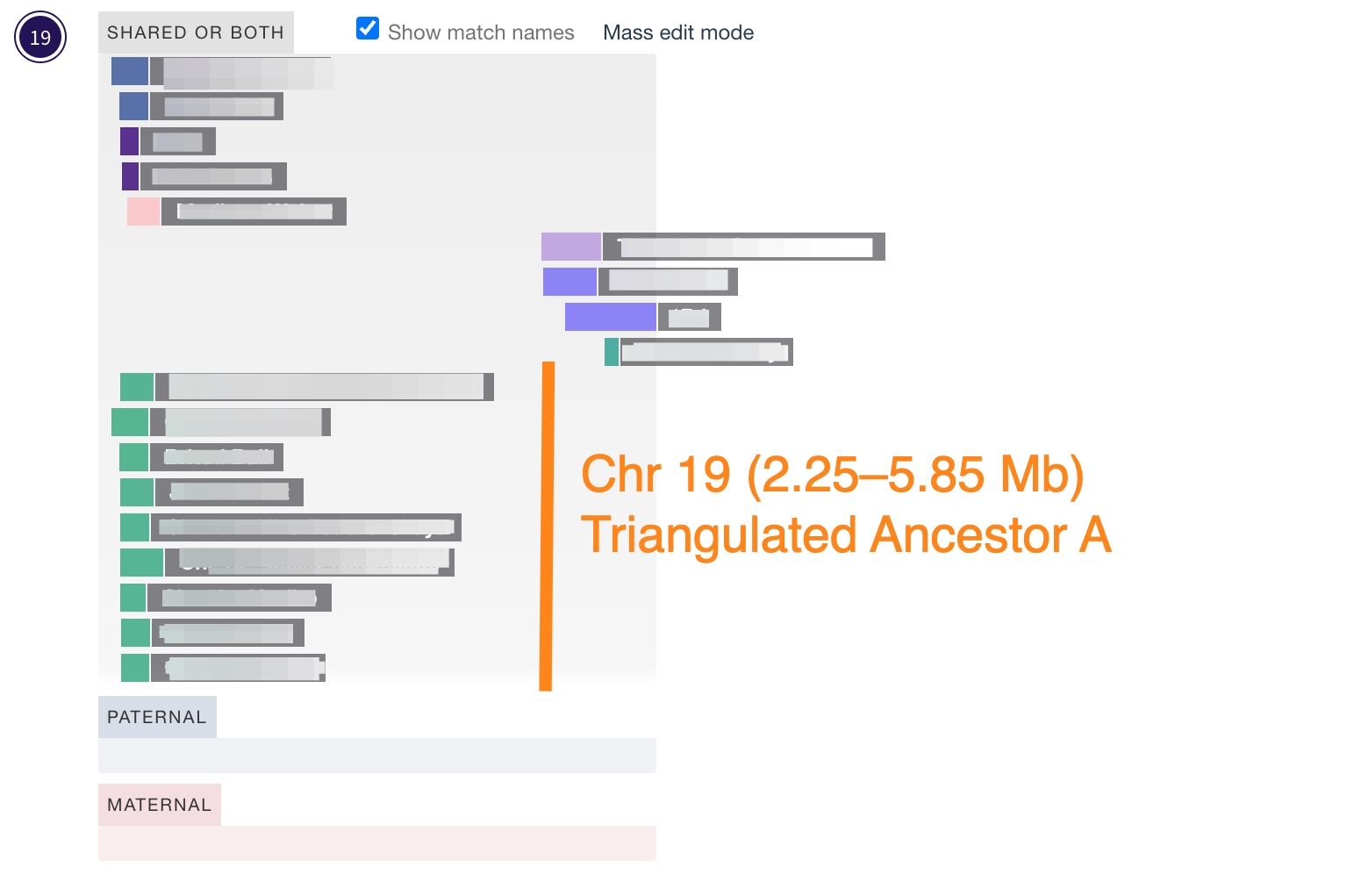
There’s a small stretch on Chromosome 19, roughly 2.25 to 5.85 Mb. Not impressive on paper. Not large enough to shout. Not the kind of match people screenshot and celebrate.
It doesn’t announce itself.
It repeats.
Across multiple people. Across platforms. Across databases that have no reason to agree with each other.
The same segment shows up again and again.
It stacks.
The boundaries hold.
New matches add weight but not width.
No smear.
No drift.
No fragmentation.
That’s not background noise. That’s inheritance sitting still.
Noise spreads. Inheritance holds its shape.
Early inheritance survives things records don’t. It survives shame. It survives disappearance. It survives adults making choices children never get to explain.
When families fracture early, kids don’t lose their DNA.
They lose their paperwork.
Why Half Relationships Make Sense Here
Many of the people tied to this segment don’t line up as full cousins. They look like halves.
On the surface, that sounds like a weakness.
It isn’t.
Half relationships mean one shared parent instead of two. Multiple households feeding the same genetic line. Children born into overlapping family structures that never quite admit they belong to each other.
That fits Earl’s early life too cleanly to ignore.
If Earl’s birth involved a remarriage, an unacknowledged relationship, a parent who disappeared, died, or couldn’t be named without consequences, this is exactly what the DNA would look like.
Moderate centimorgan totals.
Clean, repeatable segments.
Shared ancestry without tidy cousin charts to make everyone comfortable.
The DNA doesn’t contradict the record.
It explains why the record never settled down.
The Quiet Turn
Here’s the part that doesn’t announce itself.
Autosomal DNA doesn’t wait for adulthood. It doesn’t care about enlistment papers or marriage licenses. It doesn’t show up when someone becomes legible to the state.
This segment didn’t form when Earl went to work.
It didn’t form when he married.
It didn’t form when he became a man on paper.
It formed before memory.
It formed at conception.
That means the family structure that produced this DNA existed before Earl ever learned his name. And it kept echoing through collateral lines long after Earl himself was moved, renamed, and filed away.
That’s the quiet part. The part you feel more than you see.
DNA remembers the family you came from, not the one you were placed into.
Reading the Silence Differently
For years, Earl’s early timeline looked like disconnected facts.
A birth without parents listed.
A childhood without stable documentation.
A later life that suddenly snaps into focus.
Now it reads as one sentence written in pieces.
The Chromosome 19 segment points to a single ancestral source feeding multiple lines. Some stayed visible. Some vanished. Some were never allowed to speak.
Earl didn’t lack parents because there were none.
He lacked parents because the truth around his birth couldn’t be written down cleanly.
DNA doesn’t need clean stories.
It only needs repetition.
The Final Truth
This doesn’t name Earl’s parents.
It does something more dangerous than that.
It proves Earl belonged to a real, specific ancestral network. That the network fractured early. That the break happened before the records hardened. And that the DNA carried the truth forward anyway.
Those early moves in Earl’s life are no longer just poverty, chaos, or bad luck.
They’re containment.
Management.
A situation that had to be handled quietly.
The DNA didn’t forget.
It waited.
Records erase. DNA testifies.
And that’s the bigger truth this project keeps circling.
You can hide a child from paper.
You can move them, rename them, and file them under silence.
But you can’t move inheritance.
It holds.
Research Notes for Nerds (Evidence Summary)
Chromosome: 19
Coordinates: ~2.25–5.85 Mb (GRCh37/B37)
Segment size: ~13–16 cM across matches
Platforms: Confirmed on GEDmatch and 23andMe
Observed behavior:
Segment stacks vertically across multiple independent testers
Core boundaries remain stable as matches are added
No lateral extension consistent with population background or endogamy
Interpretation:
Indicates a single inherited autosomal segment
Likely transmitted through asymmetric family structure
Consistent with half relationships and early family fracture
Current classification:
Status: Triangulated
Confidence: Very likely
Ancestral couple: Unknown
Parental side: Not yet assigned
This segment will not be reclassified unless a new high-cM overlap or documentary anchor appears.
More Reading


For readers who want the evidence trail, the following notes document the sources and methods underlying the genetic analysis described above.
Receipts
International Society of Genetic Genealogy Wiki, “Autosomal DNA Statistics,” last modified 2024, https://isogg.org/wiki/Autosomal_DNA_statistics. Expected centimorgan ranges for first cousins and half first cousins are derived from aggregated empirical data across testing platforms.
Blaine T. Bettinger, “The Shared cM Project 4.0,” The Genetic Genealogist, 2020, https://thegeneticgenealogist.com/2020/09/24/shared-cm-project-4-0/. Provides observed centimorgan ranges and distributions for documented genealogical relationships, including half relationships.
International Society of Genetic Genealogy Wiki, “Triangulation,” last modified 2024, https://isogg.org/wiki/Triangulation. Defines triangulation as shared overlapping DNA segments inherited from a common ancestor and distinguishes triangulated segments from IBS (Identical by State).
Leah Larkin, “Triangulation: What It Is and What It Is Not,” The DNA Geek, 2017, https://thednageek.com/triangulation-what-it-is-and-what-it-is-not/. Discusses proper interpretation of triangulated segments and cautions against reliance on total shared DNA alone.
GEDmatch, “One-to-One Autosomal DNA Comparison Tool,” accessed January 2026, https://www.gedmatch.com. Segment-level comparisons used to confirm overlapping autosomal DNA on Chromosome 19 across multiple independent testers.
DNA Painter, “Chromosome Map and Segment Painting Tool,” accessed January 2026, https://dnapainter.com. Used to visualize, group, and evaluate autosomal DNA segment overlap and boundary stability.
Bettinger, Blaine T., and Jonny Perl, “How Endogamy and Pedigree Collapse Affect DNA Matches,” Journal of Genetic Genealogy 13, no. 2 (2018): 1–12. Establishes expected segment behavior under endogamy and distinguishes population-level background from single-source inheritance.
Jobling, Mark A., Edward Hollox, Matthew Hurles, Toomas Kivisild, and Chris Tyler-Smith, Human Evolutionary Genetics, 2nd ed. (New York: Garland Science, 2013), 315–332. Provides foundational discussion of autosomal inheritance, recombination, and segment transmission across generations.
Thompson, Elizabeth A., Statistical Inference from Genetic Data on Pedigrees (Hayward, CA: Institute of Mathematical Statistics, 2000), 87–110. Discusses inheritance patterns in incomplete and asymmetric pedigrees, including half relationships.
Douglas, Nate. “Chr 19 (2.25–5.85 Mb) — Triangulated Segment,” DNA Painter project notes, January 2026. Private research notes documenting segment boundaries, match overlap, confidence assessment, and classification criteria.
It's strangely reassuring. The segments show some human out there has segments that match, they are out there... somewhere...
I hope you find some larger matches to line up with these because the common ancestor they represent could be a long way back and difficult to pin down with any surety. Why did you conclude that these matches must be half relationships?