

Small Segments, Big Stories
Tiny DNA segments feel like evidence because they’re measurable. But in genetic genealogy, small segments are where certainty goes to die.

Abstract in plain terms
In DNA genealogy, you’ll sometimes get a match that looks tiny but official. The screen shows a neat little strip of shared DNA and a number like 9 cM. It feels like a coordinate. Like a pin dropped on a map. Like the computer just handed you a direction and said, “Go here.”
That’s the seduction.
Because 9 centimorgans is not a relationship. It’s a maybe. It can be real shared inheritance from a common ancestor. Or it can be coincidence that looks real because human DNA repeats patterns, especially in certain populations and certain parts of the genome.
A small match doesn’t show up with a warning label. It shows up like hope.
And hope is where cases get wrecked.
This essay is a field guide to that exact trap: how people take a borderline match, treat it like a breakthrough, and accidentally build a whole story on something that can’t hold weight. It explains, without drowning you in jargon, why low-cM segments are riskier, why “more little segments” can still mean nothing, and why the cleanest-looking data can still be the shakiest witness in the room.
The core idea is simple:
A segment is a clue, not a verdict.
And the smaller it is, the more careful you have to be about what you let it become.

The 9 cM Seduction: Relief, Bias, and Bad Verdicts
The fastest way to ruin a genealogy case is by falling in love with a 9 cM match.
Nine centimorgans is enough to start a rumor and not enough to earn a verdict.
It shows up like an official memo from God. A neat little strip of shared DNA with coordinates that look like a street address. Chromosome. Start. End. A tidy rectangle that feels like it came with a badge and a gun.
That is the problem.
A segment is a clue. Not a verdict.
And the lower it gets, the more it behaves like a liar in a cheap suit.
Low-cM DNA does not arrive as a warning.
It arrives as relief.
And relief is how you get sloppy.
A 9 cM match is not an answer. It is a dopamine event.
FIELD NOTE: Crime Scene
A segment is a run of autosomal DNA two people share. Companies flag it and report it, but thresholds and filters decide what you even get to see.
The trap is not the ghost
The trap is usually not a 3 cM whisper you have to drag out of the basement.
The trap is the smallest thing that still makes it through the gate.
The borderline match.
The just-barely-there segment.
The one that survives the filter and lights your brain up like a patrol car in the rearview.
Chromosome. Start. End. 9 cM. Maybe a couple more crumbs stacked behind it.
It looks like evidence.
It feels like direction.
It is often neither.
Two masks: inheritance and imitation
DNA matching wears two masks.
Identical by descent (IBD) means you share a segment because it came down from the same ancestor. Identical by state (IBS) means it looks shared because humans and populations repeat patterns like cheap wallpaper.
IBD is a witness with a name.
IBS is a stranger in the crowd wearing the same jacket.
And the low end is where IBS learns to forge handwriting.
FIELD NOTE: Failure Mode
Small segments are more likely to be false positives or population noise than clean inheritance. Treat them as high-risk leads, not verdicts.
Why the low end seduces
This work is never just data. It is always a case. The kind with missing names and institutional silence. The kind with blank parent fields that don’t feel clerical. They feel engineered. They feel like somebody closed a door and smiled while they did it.
Then a low-cM match drops into that void like a flare.
Not proof. Relief.
Your mind doesn’t greet it as weak. Your mind greets it as rescue. A hand reaching back through the paperwork. A whisper from the dead saying, finally, here.
And then the machinery starts.
The illusion of precision
A segment comes with coordinates, so it feels like location. Like you’re standing outside the right house. Like you could knock.
But clean coordinates do not guarantee clean meaning. Formatting is not truth. A crisp report can still be a shaky witness statement.
The illusion of accumulation
Once the low end becomes your hunting ground, fragments multiply. A handful of crumbs starts to feel like a loaf. Ten little segments start to feel like confirmation.
Quantity becomes comfort.
Comfort becomes conclusion.
Conclusion becomes contamination.
The illusion of alignment
A surname looks familiar. A town name hits the same nerve. A cluster hints at the same county.
Your brain does what it was built to do.
It draws a straight line through fog and calls it a road.
A pile of low-cM fragments is not evidence.
It is temptation with math on it.
The people who don’t get played by 9 cM
Genealogists who actually know low-centimorgan work aren’t doing parlor tricks. They’ve spent years in the 6–20 cM swamp where most matches are distant, ambiguous, and easy to misread. Their “experience” isn’t naming an ancestor from 9 cM like it’s a psychic reading. Their experience is knowing how to control for noise, resist narrative hunger, and keep the case from getting contaminated by false certainty.
The way they talk is the first tell. Low-cM matches are high-risk leads, not proofs, so their language stays conservative. You’ll hear suggests, consistent with, possible, worth exploring, not confirms or proves. That’s not politeness. That’s chain of custody.
Their process starts with context, not the glittering rectangle. Total shared cM. Largest segment. Segment count. Shared matches. Platform. Test version. Population history. They pay attention to endogamy and pedigree collapse because those conditions inflate match lists and make “small segments everywhere” a normal background hum instead of a smoking gun.
They also tend to be comfortable with statistics because low-cM work is measured in confidence, not vibes. Relationship estimates are probabilities, not prophecies. Instead of asking “Is this the ancestor?” they ask, “How likely is this inherited versus coincidental?” and they treat uncertainty like it’s normal because it is.
When they do triangulate, they do it with discipline: same segment, same location, matches who also match each other on that segment, and a hypothesis that survives outside the DNA. They’re willing to say triangulation fails, because they’re not trying to win a story. They’re trying to avoid a bad verdict.
Most of all, they demand independent evidence: records, geography, timelines, known relatives, rival hypotheses written down like suspects, not brushed aside like insults.
FIELD NOTE: Lab Conditions
Endogamy, pile-up regions, and platform thresholds can make low-cM matches look meaningful when they’re just background noise.
What 9 cM means statistically: Most distant common ancestors
Here’s the part nobody wants to hear when they’re high on that 9 cM hit.
A 9 cM match has a wide range of possible relationships. In the Shared cM Project probability view at DNA Painter (which uses probability tables from The DNA Geek), a 9 cM match can point to common ancestors as “close” as the 8th-great-grandparent level, or as far back as 20 or more generations. That’s not a typo. Twenty-plus.
And the probability spread is brutal. The same tool shows most of the probability mass sitting out in distant-cousin territory. The biggest bucket is dominated by sixth cousins and similarly distant equivalents. Smaller chunks of probability include fourth cousin ranges, then third cousin ranges, with only a tiny sliver assigned to anything that feels “close.”
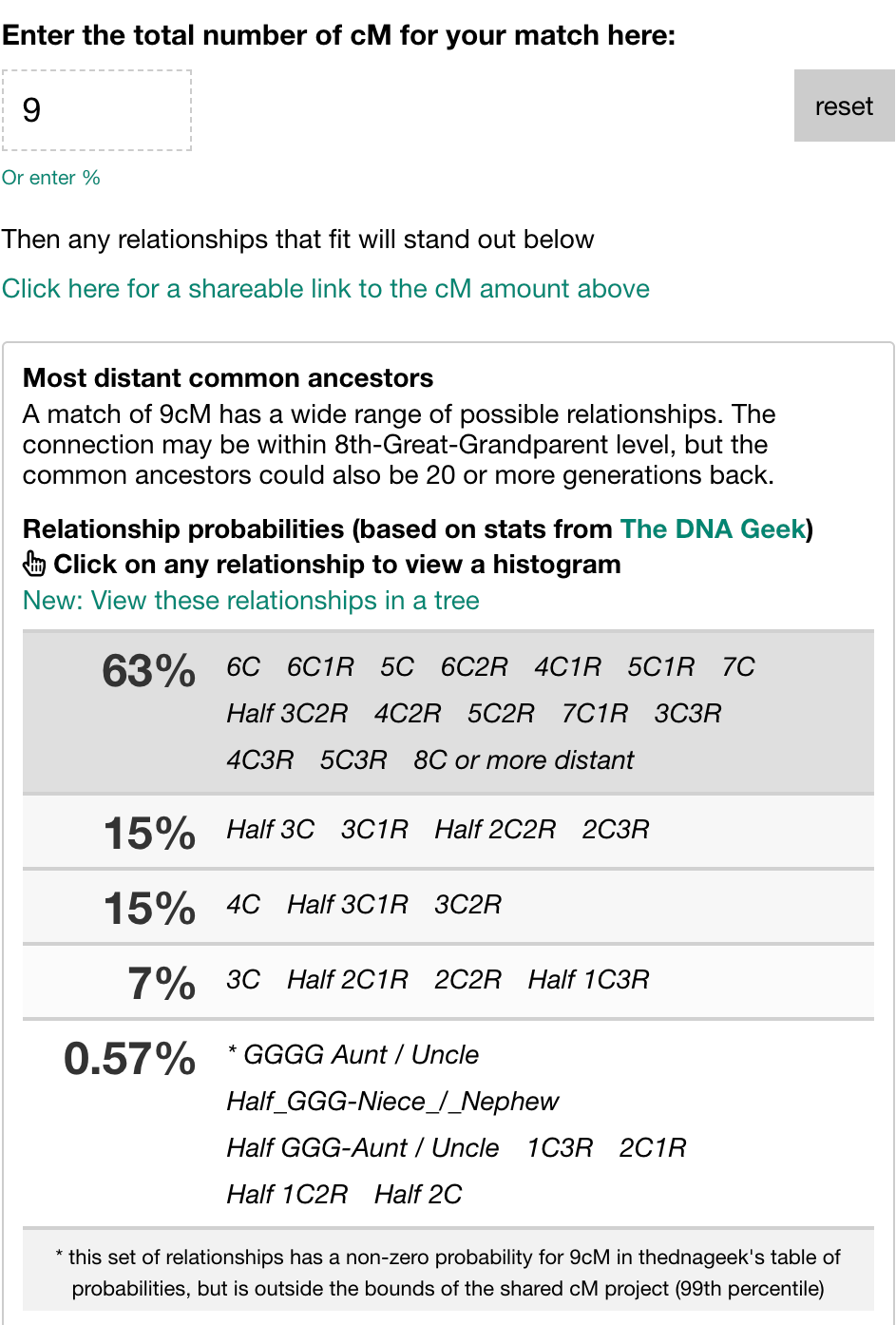
Translation: 9 cM is not a person. It’s a weather report. It tells you conditions, not identity.
So if you catch yourself staring at a 9 cM segment like it’s a confession, you’re not doing genealogy anymore.
You’re doing fan fiction in a lab coat.
The technical rot under the floorboards
This is the part that offends people because it kills the fantasy of certainty. Good. Certainty is cheap. Accuracy costs more.
Endogamy: the crowded bar problem
In endogamous or founder populations, low-cM segments behave like background radiation. Repeated intermarriage over generations produces match lists that look like a riot.
In a crowded bar, everyone brushes shoulders. That does not mean anyone came together.
A 9 cM segment in an endogamous context can be a chorus of ancestors whispering at once. Not a clean line. A crowded room.
Pile-up regions: the genome’s bad neighborhoods
Some parts of the genome are match magnets. People match there again and again. If you lean too hard on those regions, you’re not identifying a suspect. You’re misreading the neighborhood.
It’s fingerprint dust on every surface.
Platform thresholds and algorithm fog
Different companies use different SNP arrays. Marker density varies. Some data is inferred. Boundaries drift. Segments break or shrink depending on method and threshold.
A big solid segment usually survives the trip.
A borderline segment wobbles.
The same match can look stronger on one platform and weaker on another, not because the ancestor changed, but because the measuring tape did.
Coincidence loves the low end
As segment size drops, IBS rises. Not always. But often enough that the low end must be treated as high risk.
This is where caution becomes a professional obligation.
The biggest scam
A long list of small segments does not equal closeness.
A match profile can show many pieces and still be distant. Or multiply related. Or connected through population signal that does not map cleanly to one recent ancestor with a name you can hold in your hand.
A case goes bad when “many segments” becomes “must be close.”
That is how trees get contaminated.
The match gets promoted to suspect.
The suspect gets promoted to conclusion.
The conclusion gets written into a tree.
The tree gets copied.
The copy becomes consensus.
Consensus is not proof. Consensus is just a crowd.
FIELD NOTE: Chain of Custody
If the segment is borderline, the language must be borderline. Not proves. Not confirms. Suggests. Consistent with. Possible.
Triangulation is not holy water
Triangulation is a tool, not a blessing.
Real triangulation is disciplined. Same location. Same segment. Matches who also match each other on that segment. A hypothesis that survives outside the DNA.
But the low end invites abuse. You can triangulate noise. You can triangulate population signal. You can triangulate a pile-up region and call it revelation.
If the segment is borderline, the test is weak.
If the test is weak, the confidence must be weaker.
Here is what I did not want to admit
Low-cM segments do not hook a case because they are strong.
They hook because the file is exhausting.
After enough blank spaces, anything shaped like an answer starts to look like an answer. A 9 cM scrap can feel like the past finally blinking at you through the paperwork.
It is not the past.
It is your nervous system trying to end the story.
That is the moment the investigator becomes the biggest risk to the case.
FIELD NOTE: Protocol
Classify low-cM as high-risk. Check total cM, largest segment, segment count. Check shared matches for convergence. Phase when possible. Pressure test with records. Write conclusions that can be disproven.
The final punch
Low-cM segments are not useless. They can point toward a community. Suggest a cluster. Whisper about deep ancestry. Nudge you toward the right courthouse, the right church, the right institution, the right ledger where a woman’s name was written and then buried under bureaucracy.
But a borderline scrap is not a verdict.
If it becomes a verdict, the case does not just get solved wrong. It gets solved loud. It gets copied. It gets repeated. It becomes the new myth. It becomes the new silence.
A second erasure, committed by descendants who thought they were rescuing the truth.
So handle the low end like a tip from a drunk at closing time.
Write it down.
Follow it.
Test it.
Never worship it.
Because the DNA is not lying.
The danger is what your mind will do with relief when it finally finds something it can point at.
Receipts
Ancestry. “AncestryDNA® Matching Updates.” Ancestry Support. Accessed December 27, 2025. https://support.ancestry.com/s/article/AncestryDNA-Matching-Updates?language=en_US.
Ancestry. “How Timber Helps You Find Meaningful DNA Matches.” Ancestry Support. Accessed December 27, 2025. https://support.ancestry.com/s/article/How-Timber-Helps-You-Find-Meaningful-DNA-Matches?language=en_US.
Bartlett, Jim. “Pile-ups.” Segmentology. October 7, 2015. Accessed December 27, 2025. https://segmentology.org/2015/10/07/pile-ups/.
Bettinger, Blaine T. “An In-Depth Analysis of the Use of Small Segments as Genealogical Evidence.” The Genetic Genealogist. August 7, 2022. Accessed December 27, 2025. https://thegeneticgenealogist.com/2022/08/07/an-in-depth-analysis-of-the-use-of-small-segments-as-genealogical-evidence/.
Bettinger, Blaine T. “Analyzing Segment Frequency at GEDmatch.” The Genetic Genealogist. August 13, 2017. Accessed December 27, 2025. https://thegeneticgenealogist.com/2017/08/13/analyzing-segment-frequency-at-gedmatch/.
Bettinger, Blaine T. “A Triangulation Intervention.” The Genetic Genealogist. June 19, 2016. Accessed December 27, 2025. https://thegeneticgenealogist.com/2016/06/19/a-triangulation-intervention/.
Bettinger, Blaine T. “Family Tree DNA Updates Matching Thresholds.” The Genetic Genealogist. May 24, 2016. Accessed December 27, 2025. https://thegeneticgenealogist.com/2016/05/24/family-tree-dna-updates-matching-thresholds/.
Bettinger, Blaine T. “The Shared cM Project: A Demonstration of the Power of Citizen Science.” Journal of Genetic Genealogy 8, no. 1 (2016): 38–42. Accessed December 27, 2025. https://jogg.info/wp-content/uploads/2021/09/81.006.pdf.
Cooper, Kitty. “Endogamy and DNA.” Kitty Cooper’s Blog. February 25, 2017. Accessed December 27, 2025. https://blog.kittycooper.com/2017/02/endogamy-and-dna/.
Dyer, Nicole Elder. “Endogamy, Pedigree Collapse, and Multiple Relationships: What’s the Difference and Why Does It Matter?” Family Locket. September 2, 2022. Accessed December 27, 2025. https://familylocket.com/endogamy-pedigree-collapse-and-multiple-relationships-whats-the-difference-and-why-does-it-matter/.
FamilyTreeDNA. “New Functionality For The Family Finder™ Matrix.” FamilyTreeDNA Blog. February 13, 2025. Accessed December 27, 2025. https://blog.familytreedna.com/family-finder-matrix-update/.
International Society of Genetic Genealogy (ISOGG). “Autosomal DNA match thresholds.” ISOGG Wiki. Accessed December 27, 2025. https://isogg.org/wiki/Autosomal_DNA_match_thresholds.
International Society of Genetic Genealogy (ISOGG). “Endogamy.” ISOGG Wiki. Updated December 10, 2025. Accessed December 27, 2025. https://isogg.org/wiki/Endogamy.
International Society of Genetic Genealogy (ISOGG). “Identical by descent.” ISOGG Wiki. Accessed December 27, 2025. https://isogg.org/wiki/Identical_by_descent.
International Society of Genetic Genealogy (ISOGG). “Identical by state.” ISOGG Wiki. Accessed December 27, 2025. https://isogg.org/wiki/Identical_by_state.
Larkin, Leah. “AncestryDNA’s 2020 Matching White Paper.” The DNA Geek. July 17, 2020. Accessed December 27, 2025. https://thednageek.com/ancestrydnas-2020-matching-white-paper/.
Legacy Tree Genealogists. “Dealing with Endogamy, Part 1: Exploring Shared DNA.” Legacy Tree Genealogists (blog). October 13, 2016. Accessed December 27, 2025. https://www.legacytree.com/blog/dealing-endogamy-part-exploring-amounts-shared-dna.
Perl, Jonny. “Shared cM Project 4.0 Tool v4 with relationship probabilities.” DNA Painter. March 26, 2020. Accessed December 27, 2025. https://dnapainter.com/tools/sharedcmv4.
23andMe. “DNA Relatives: Detecting Relatives and Predicting Relationships.” 23andMe Customer Care. Accessed December 27, 2025. https://customercare.23andme.com/hc/en-us/articles/212170958-DNA-Relatives-Detecting-Relatives-and-Predicting-Relationships.
Zhou, Ying, Sharon R. Browning, and Brian L. Browning. “A Fast and Simple Method for Detecting Identity-by-Descent Segments in Large-Scale Data.” The American Journal of Human Genetics 106, no. 4 (April 2, 2020): 426–437. https://pmc.ncbi.nlm.nih.gov/articles/PMC7118582/.
I have never been able to figure out such small seqments because I cannot do the paper trail back that far. I hope that eventually you find something that brings you some information about your father's line. So far looking pretty bleak from where I sit.
So glad to see someone tease this apart and acknowledge how difficult it can be to "resist narrative hunger."