

Chromosome 6 Started Talking
The first confirmed triangulation structure in the Earl Douglas investigation survived every attempt to explain it away.

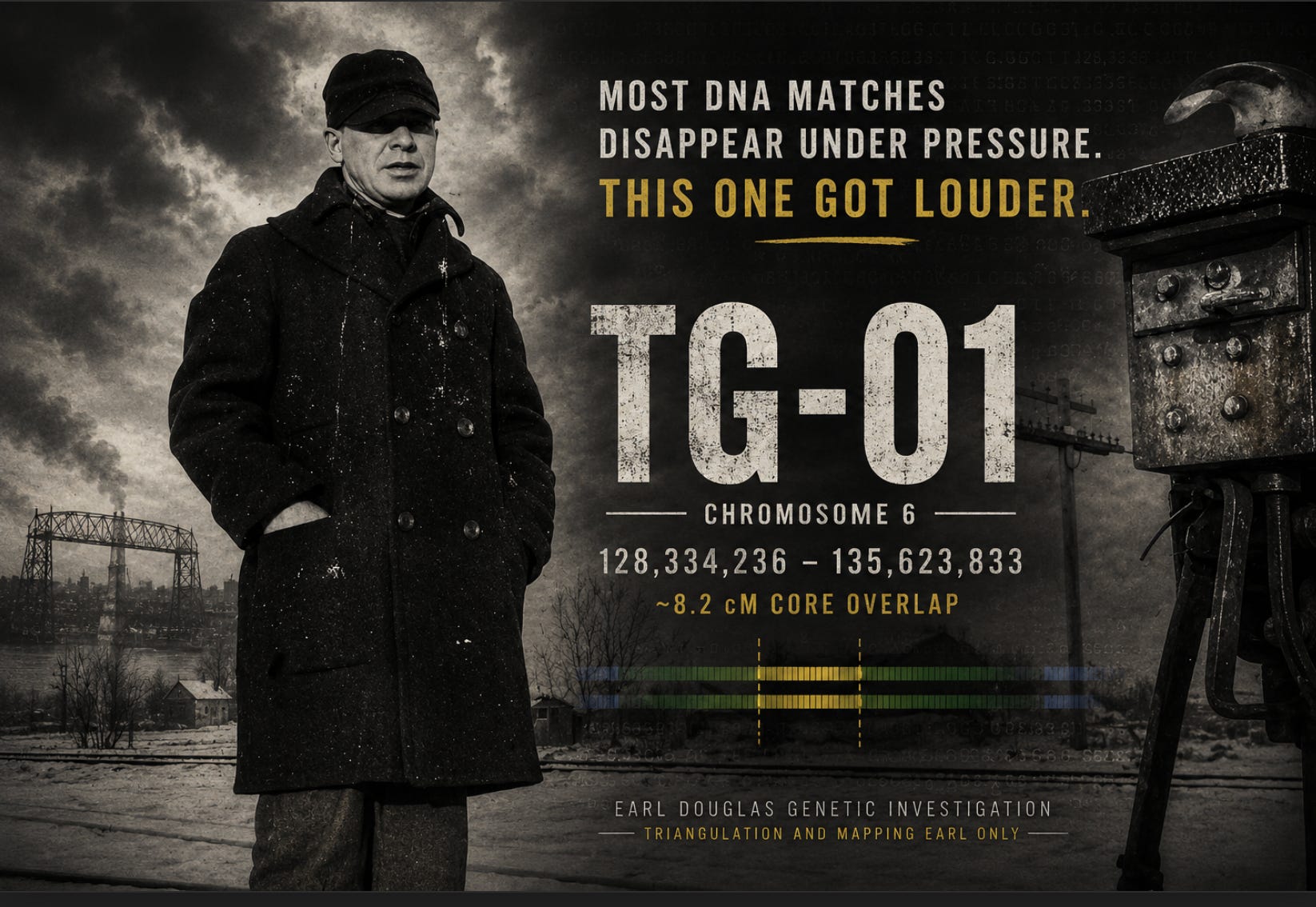
Most DNA matches disappear under pressure.
This one got louder.
REPORT METADATA
Project: Earl Douglas Genetic Investigation
Subject: TG-01 Chromosome 6 Triangulation Structure
Researcher: Nate Douglas
Date Prepared: 17 May 2026
Version: v1.0
Report Classification: Narrative Investigative Essay
Methodology: DNA-First Forensic Genealogy
Primary Analytical Platforms: GEDmatch, DNA Painter
Research Phase: Phase 3, Segment-Level Validation
TABLE OF CONTENTS
1.Executive Summary
2. The Problem with Noise
3. The City That Erased People
4. What Triangulation Actually Means
5. The Segment That Survived
6. Why TG-01 Matters
7. What the Segment Does Not Prove
8. The Psychological Shift
9. Current Assessment
10. Next Research Actions
11. Closing Notes
1. EXECUTIVE SUMMARY
Before TG-01, the investigation was noise.
Low-centimorgan fragments. Broken records. Shared matches without stable structure. A century-old disappearance buried beneath industrial migration, incomplete census data, institutional silence, and fragmented inheritance patterns that refused to stabilize into anything reproducible.
Then the dark started developing structure.
TG-01 represents the first confirmed triangulation group identified within the Earl Douglas Genetic Investigation. Reciprocal chromosome 6 comparison testing confirmed that multiple independent DNA participants not only matched the researcher across the same genomic interval, but also matched each other across the same surviving overlap interval.
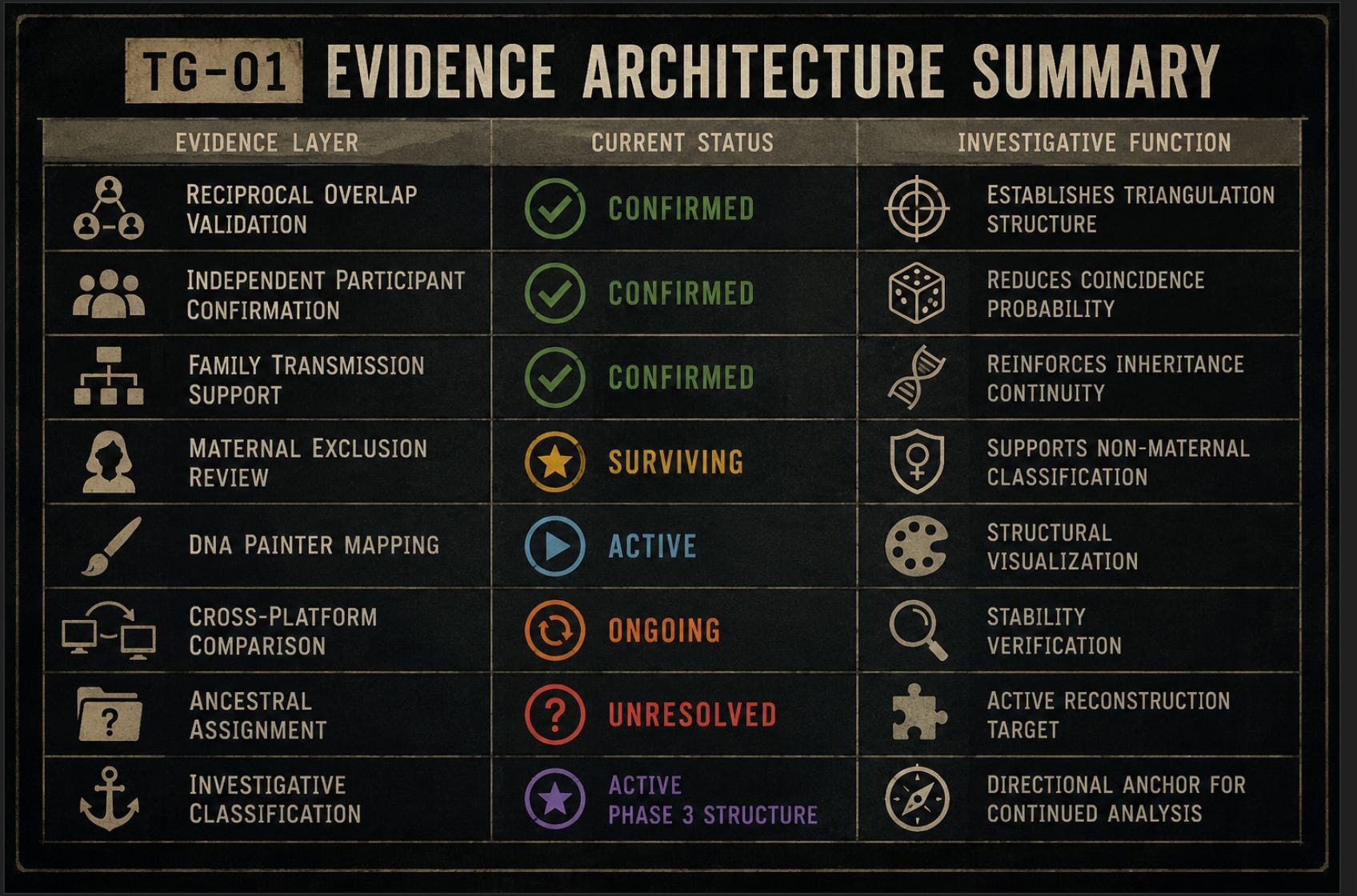
The chromosome 6 interval survived reciprocal comparison review, overlap consistency testing, family-duplication analysis, and maternal exclusion assessment, materially strengthening confidence that the segment represents legitimate inherited shared DNA rather than random low-centimorgan coincidence or platform artifact.
Although the triangulation structure itself is now considered structurally validated, the ancestral source responsible for the segment remains unresolved. Current evidence therefore supports the existence of a real inherited chromosomal structure connected to the broader Earl Douglas investigation, but does not yet establish final biological parentage or definitive genealogical assignment.
TG-01 presently functions as both a confirmed evidence structure and a directional investigative anchor within ongoing Phase 3, Segment-Level Validation.
People outside forensic genealogy imagine DNA as certainty.
It isn’t.
DNA is pressure.
Especially in unresolved parentage investigations.
The farther you move away from close relatives, the more the evidence begins fracturing into low-centimorgan debris: tiny inherited fragments drifting through generations like shrapnel after an explosion nobody documented correctly.
That is the hidden reality of this work.
You spend months staring into overlap tables wondering whether the evidence means anything at all.
Everyone matches everyone a little.
Trees are broken.
Genealogists, family historians, archivists actively copy each other’s errors.
Platforms disagree.
The companies controlling the largest DNA databases often wall off the very tools needed to validate the evidence. Segment data gets restricted. Chromosome browsers disappear. Cross-platform comparison becomes fragmented behind corporate ecosystems, subscription layers, and proprietary barriers that actively interfere with independent forensic reconstruction work.
Researchers end up investigating century-old disappearances through keyholes controlled by private platforms, human error, and genetic entropy.
And every new segment arrives carrying the same question:
Is this structure?
Or just statistical weather?
Most of the time, the answer is disappointing.
Except for this time.
3. THE CITY THAT ERASED PEOPLE
To understand why TG-01 matters, you have to understand Duluth.
Not the tourism-brochure version.
The Zenith City few people talk about.
If you know, you know.
Duluth in the 1890s was industrial violence disguised as opportunity. Ore docks. Timber routes. Boarding houses. Sailors. Rail workers. Domestic laborers. Immigrants arriving faster than institutions could document them. People moved through the city faster than bureaucracy could record them.
This was not a stable society. It was a human sorting machine built beside deep, cold water and iron money.
People arrived carrying entire lives inside a suitcase and disappeared into boarding houses, labor camps, ore freighters, brothels, poor farms, rail yards, kitchens, dock crews, and census gaps.
That environment matters.
Because Earl Douglas does not emerge from a clean genealogical landscape.
Earl Douglas emerges from the historical record like impact debris.
Because Earl Douglas appears inside the historical record like impact debris.
No parents listed.
No stable household.
No confirmed early census placement.
A child eventually appearing in someone else’s home while the documentary system behind him collapses into silence.
Most genealogy assumes records failed accidentally.
I no longer believe that.
Industrial America was an identity machine.
It categorized useful people and discarded the rest.
Some families inherited property.
Others inherited disappearance.
4. WHAT TRIANGULATION ACTUALLY MEANS
One of the biggest misconceptions in genetic genealogy is the belief that shared matches automatically equal shared ancestry.
They don’t.
“Everyone matches me” is not triangulation.
That is probability.
Triangulation begins when independent people also match each other across the same surviving chromosome interval.
That distinction matters enormously.
TG-01 changed the investigation because the structure stopped behaving randomly.
The researcher matched JMO-A01-N16cM.
The researcher matched DMC-B01-N20cM.
Then JMO-A01-N16cM and DMC-B01-N20cM also matched each other across the same surviving chromosome 6 interval.
That is not narrative.
That is structure.
And structure changes everything.
Because once a segment survives reciprocal comparison testing, it becomes much harder to dismiss as coincidence.
The chromosome starts pushing back.
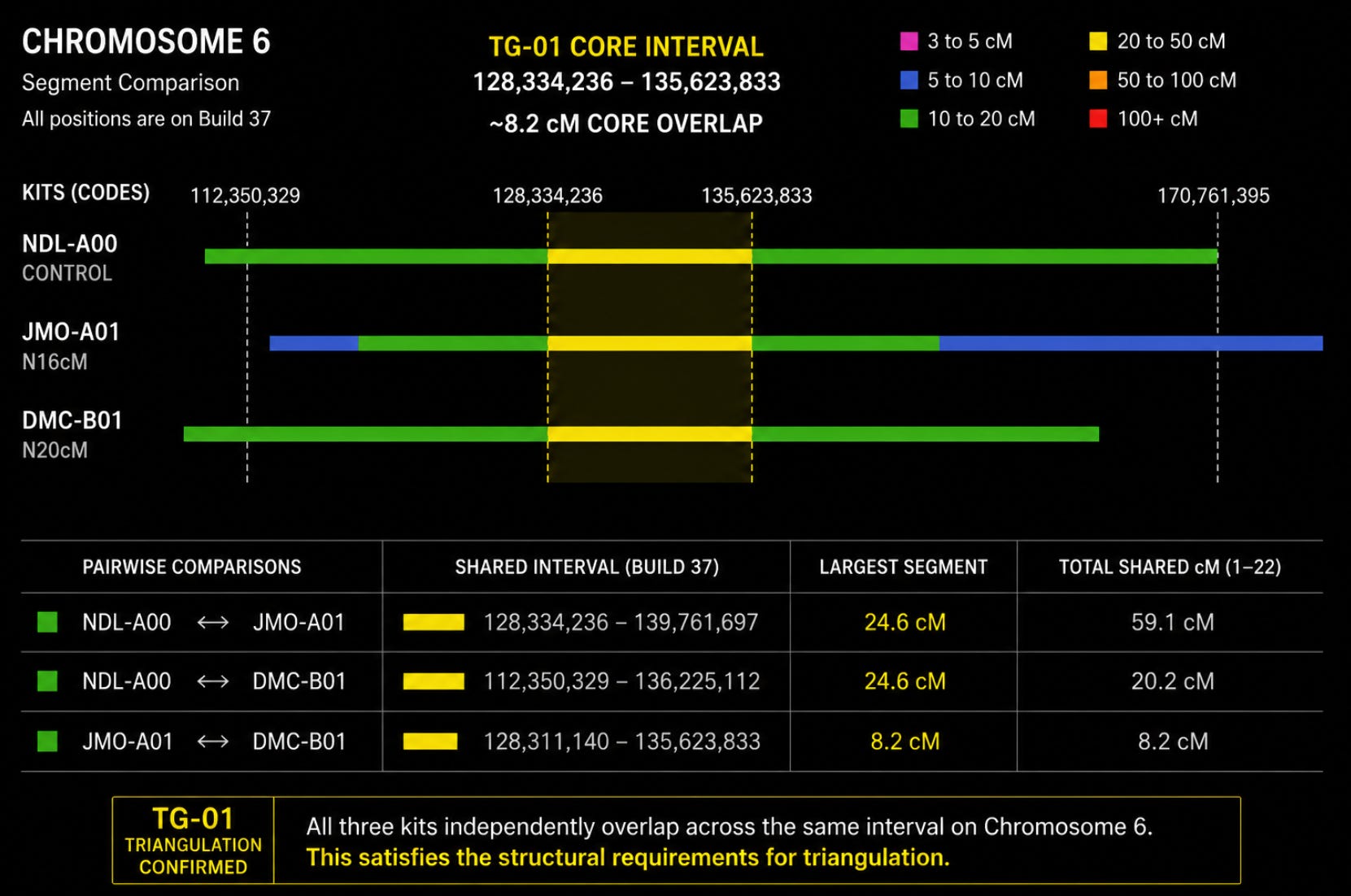
This visualization documents the stabilized TG-01 triangulation interval identified during Phase 3: Segment-Level Validation of the Earl Douglas Genetic Investigation. The graphic demonstrates reciprocal segment overlap across Chromosome 6 between three independently tested kits: NDL-A00-Control, JMO-A01-N16cM, and DMC-B01-N20cM.
The highlighted interval represents the surviving TG-01 core overlap region at Chr 6: 128,334,236–135,623,833 (Build 37), where all three kits independently overlap across the same chromosomal segment. Pairwise comparison data confirms that each participant matches the others across the surviving interval, satisfying the structural requirements for confirmed triangulation.
This visualization does not represent simple shared matching or algorithmic clustering. It represents reciprocal segment confirmation across an independently surviving chromosomal interval.
5. THE SEGMENT THAT SURVIVED
This is the part that stayed with me.
The segment survived pressure.
That sounds simple until you understand what pressure means in forensic genealogy.
TG-01 survived:
reciprocal comparison review
overlap consistency testing
family duplication analysis
maternal exclusion review
repeated segment verification
low-cM scrutiny
cross-platform comparison
Every stage was another opportunity for the structure to collapse.
It didn’t.
That changes the emotional gravity of the investigation completely.
Because eventually you stop asking:
“Does something exist here?”
And start asking:
“Why does this keep surviving every attempt to explain it away?”
That is a very different psychological landscape.
At that point the investigation stops feeling like ancestry research and starts feeling like reconstruction after impact.
6. WHY TG-01 MATTERS
TG-01 does not solve the Earl Douglas case.
Not even close.
But it does something equally important.
It establishes continuity.
For the first time in the investigation, the evidence stabilized into a repeatable inherited structure surviving across multiple independent participants.
That matters because forensic genealogy is not built from dramatic revelations.
It is built from surviving pressure.
The segment remained.
And once that happens, the case changes permanently.
Because now the investigation has an anchor point: a real chromosomal structure that can be tested, expanded, challenged, and compared against future evidence.
Before TG-01, the investigation was mostly directional.
After TG-01, the DNA began establishing boundaries.
The dark started developing edges.
7. WHAT THE SEGMENT DOES NOT PROVE
This is the part people hate hearing.
TG-01 does not identify Earl Douglas’s biological parents.
It does not independently prove McKay ancestry.
It does not prove McLaughlin ancestry.
It does not prove County Mayo origin.
It does not prove Ulster origin.
DNA does not give confessions.
It gives witnesses.
The chromosome cannot tell you names.
What it can tell you is that somewhere behind the silence, behind the missing census lines, behind the institutional collapse and erased identities, real human continuity survived.
That matters.
Even when the names do not.
8. THE PSYCHOLOGICAL SHIFT
Something changes when a triangulated structure survives long enough.
The work stops feeling hypothetical.
You stop looking at the chromosome as data and start seeing it as persistence.
That’s difficult to explain unless you’ve worked one of these cases yourself.
Because the investigation starts developing resistance.
The DNA stops acting passive.
The evidence starts imposing constraints whether you want them or not.
That is why forensic genealogy can become psychologically dangerous.
Not because the DNA lies.
Because eventually it refuses to.
9. CURRENT ASSESSMENT
The Earl Douglas investigation remains unresolved.
No definitive parental assignment has yet been established.
However, the investigation has now crossed an important threshold: the DNA evidence no longer behaves as isolated coincidence. The chromosome 6 TG-01 structure demonstrates measurable inherited continuity surviving across independent participants under reciprocal validation standards.
The significance of TG-01 is cumulative rather than conclusive.
Its value increases every time:
another independent overlap survives,
another migration corridor recurs,
another cluster stabilizes,
or another segment refuses to disappear.
The investigation remains ongoing.
10. NEXT RESEARCH ACTIONS
Immediate objectives include:
expansion of independent triangulation groups
continued segment-level validation
recruitment of additional chromosome-browser-confirmed participants
expansion of non-maternal overlap analysis
continued Duluth directory extraction
comparative analysis involving TG-03 upstream structural environments
reconstruction of recurring migration pathways involving Mayo, Ulster, Ontario, Nova Scotia, and Great Lakes industrial corridors
pressure-testing all active hypotheses against surviving chromosomal structures
Future work will continue prioritizing structural persistence over narrative assumption.
11. CLOSING NOTES
I think that’s the real lesson hiding inside all of this.
The records forgot these people.
The city buried them.
The institutions failed them.
But the DNA kept recognizing them anyway.
Once the noise answers back, the investigation changes permanently.
Appendix A: Match Coding Reference System
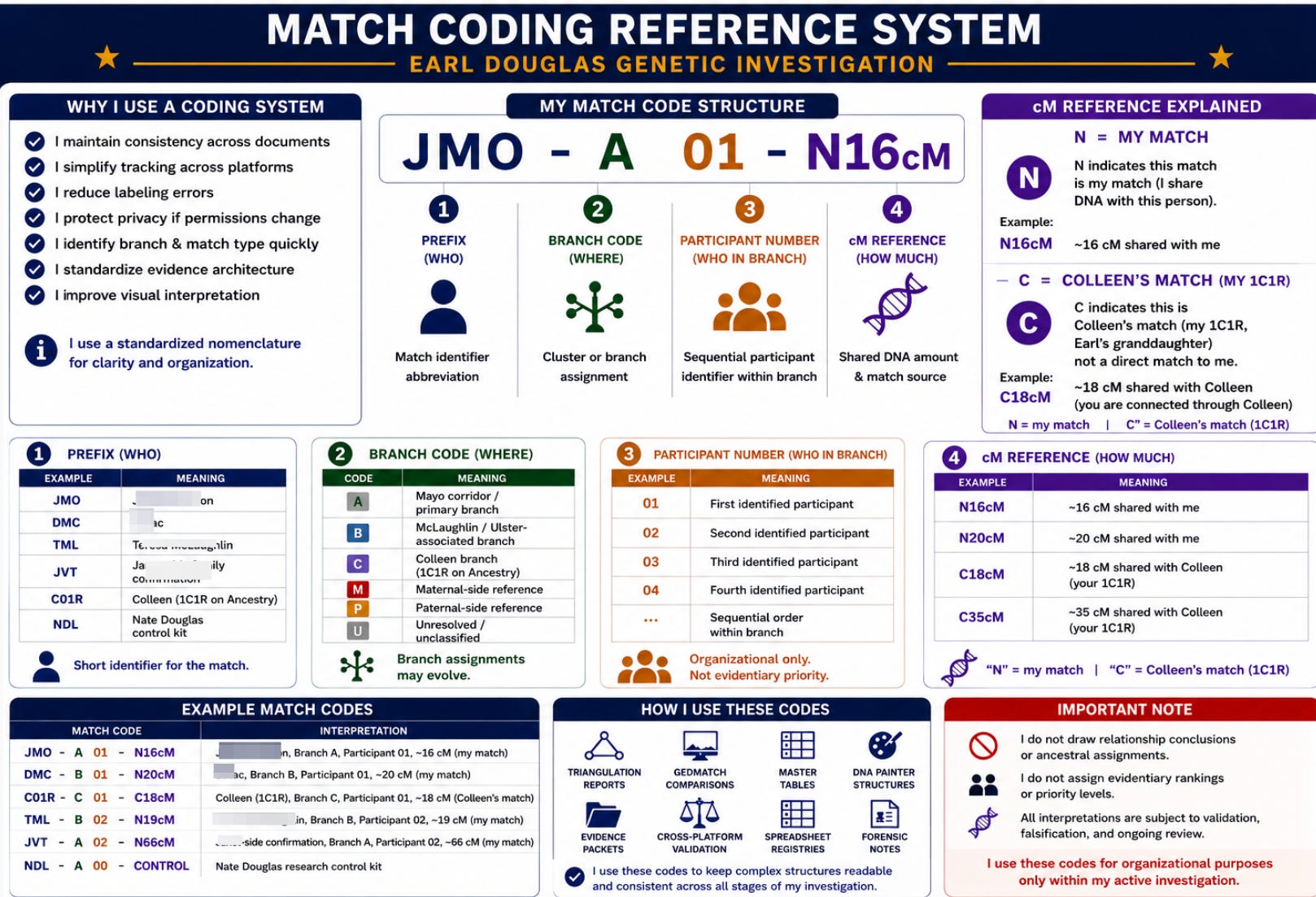
Most atDNA matches I have been working with have given me permission to use their names and information. However, I developed a standardized coding system for writing and sharing research reports. The purpose is to protect the privacy of living individuals while maintaining consistent documentation across the Earl Douglas Genetic Investigation. It’s also more helpful because their cM value is included in their code, making it easier to remember and look up.
Each match receives a structured identifier that preserves analytical value without requiring public disclosure of personal information. The coding system also allows rapid identification of cluster association, match type, branch grouping, and approximate centimorgan strength during segment analysis, triangulation review, and report construction.
This is the current structure.
More Proof


Works Cited | Activity Log
Douglas, Nate. Conditions of Evidence: Earl Douglas Genetic Investigation. Internal research framework document. Version 1.0. Unpublished report, 2026.
Douglas, Nate. Earl Douglas Genetic Investigation: Phase 1: Pre-Declared Research Design, Scope Control, and Evidentiary Standards. Version 1.0. Unpublished report, 2026.
Douglas, Nate. Earl Douglas Genetic Investigation: Phase 2: Off-Platform Cluster Isolation from 1C1R AncestryDNA Matches. Version 1.0. Unpublished report, 2026.
Douglas, Nate. Earl Douglas Genetic Investigation: Phase 2: DNA Analysis and Parent-Side Validation. Version 1.0. Unpublished report, 2026.
Douglas, Nate. Earl Douglas Genetic Investigation: TG-01 Validation Report. Phase 3: Segment-Level Validation. Version 2.1. Unpublished report, 2026.
Douglas, Nate. TG-01 Evidence Packet. Phase 3: Segment-Level Validation. Version 1.0. Unpublished report, 2026.
Douglas, Nate. Master Segment Table. Earl Douglas Genetic Investigation working database. Continuously updated internal research document, 2026.
GEDmatch. “One-to-One Autosomal DNA Comparison Tool.” Accessed 17 May 2026.
GEDmatch. “People Who Match Both, or 1 of 2 Kits Tool.” Accessed 17 May 2026.
GEDmatch. “Chromosome Browser Tool.” Accessed 17 May 2026.
Janet Morrison DNA kit T768128. GEDmatch segment comparison data accessed May 2026.
DMac DNA kit CF6964748. GEDmatch segment comparison data accessed May 2026.
Douglas, Nate, DNA kit GR4485471. GEDmatch segment comparison data accessed May 2026.