

The Dark Has Edges
After years of chasing Earl Douglas through missing records, false starts, and family fog, the chromosome map is finally starting to show where the silence has borders.

DNA does not hand you the truth.
It hands you a crime scene, a flashlight with dying batteries, and a spreadsheet full of suspects who may or may not belong in the room.
That is where I am now.
Not at the end.
Not at the revelation.
Not at the grand ancestral fireworks show where the heavens open and some dead man finally signs the paperwork.
I am in the part nobody romanticizes.
The rebuild.
The cleanup.
The part where you realize the map you built was not wrong, exactly. It was just too crowded, too noisy, too eager to believe every little match was a clue instead of a raccoon in a trench coat.
So I started over.
Again.
Not because the evidence disappeared. Not because the DNA changed. Not because some new record came strutting out of the fog carrying Earl Douglas’s parents in a manila envelope.
Because this work is hard to hold in your head.
Chromosome mapping sounds clean when you say it fast.
Segment. Match. Overlap. Triangulation. Paint it. Label it. Move on.
That is a lie with a lab coat, a lanyard, and absolutely no business being in the building.
In reality, one match turns into five. Five turns into a cluster. The cluster turns into a spreadsheet. The spreadsheet turns into a swamp. Suddenly you are staring at chromosome coordinates, kit numbers, shared matches, family echoes, half-remembered surnames, and some tiny 8 cM segment that may be gold, garbage, or a ghost with paperwork.
So I stopped.
I cleaned the table.
I rebuilt the system.
I renamed the matches.
I separated real triangulation from family echo.
I put every piece back where it belongs.
That is not failure.
That is the work.
Because Earl Douglas has been buried under silence for 130 years, and I am not going to solve him by throwing glitter at a chromosome browser and calling it proof.
This phase of the project is about slowing down enough to make the DNA tell the truth.
Not the truth I want.
The truth it can actually support.
For years, Earl Mack Douglas looked like a man born out of smoke.
A birth record with no parents listed.
A childhood that refuses to explain itself.
A name that keeps changing clothes in the dark.
Earl Mack Douglas.
Earl McKay Douglas.
Earl M. Douglas.
That middle name sits there like a cigarette burn in the file.
McKay.
Maybe it means nothing. Maybe it means everything. Genealogy loves to do that. It hands you a clue, then watches you chew glass trying to prove whether it was a clue at all.
So I did what every reasonable person does after eleven years of banging their head against a brick wall.
I stopped asking the records to confess.
I went to the chromosomes. The segments.
Not because DNA is magic. It is not. DNA is not a crystal ball. It does not whisper your ancestor’s name in a velvet Scottish accent while thunder rolls over County Mayo.
DNA is evidence.
And evidence has to be dragged into the light, measured, cross-examined, mapped, and forced to either stand up or crawl back into the swamp.
That is where this part of the project begins.
With chromosome mapping.
With triangulation.
With the cold little coordinates where the past left fingerprints.
The problem with AncestryDNA
AncestryDNA gave me the match list.
That is the big ocean.
But Ancestry does not give us a chromosome browser. No segment map. No coordinates. No way to see exactly where two people match on the genome.
So you get names, centimorgans, shared matches, trees if you are lucky, and a lot of digital shrugging.
That is useful.
But it is not enough.
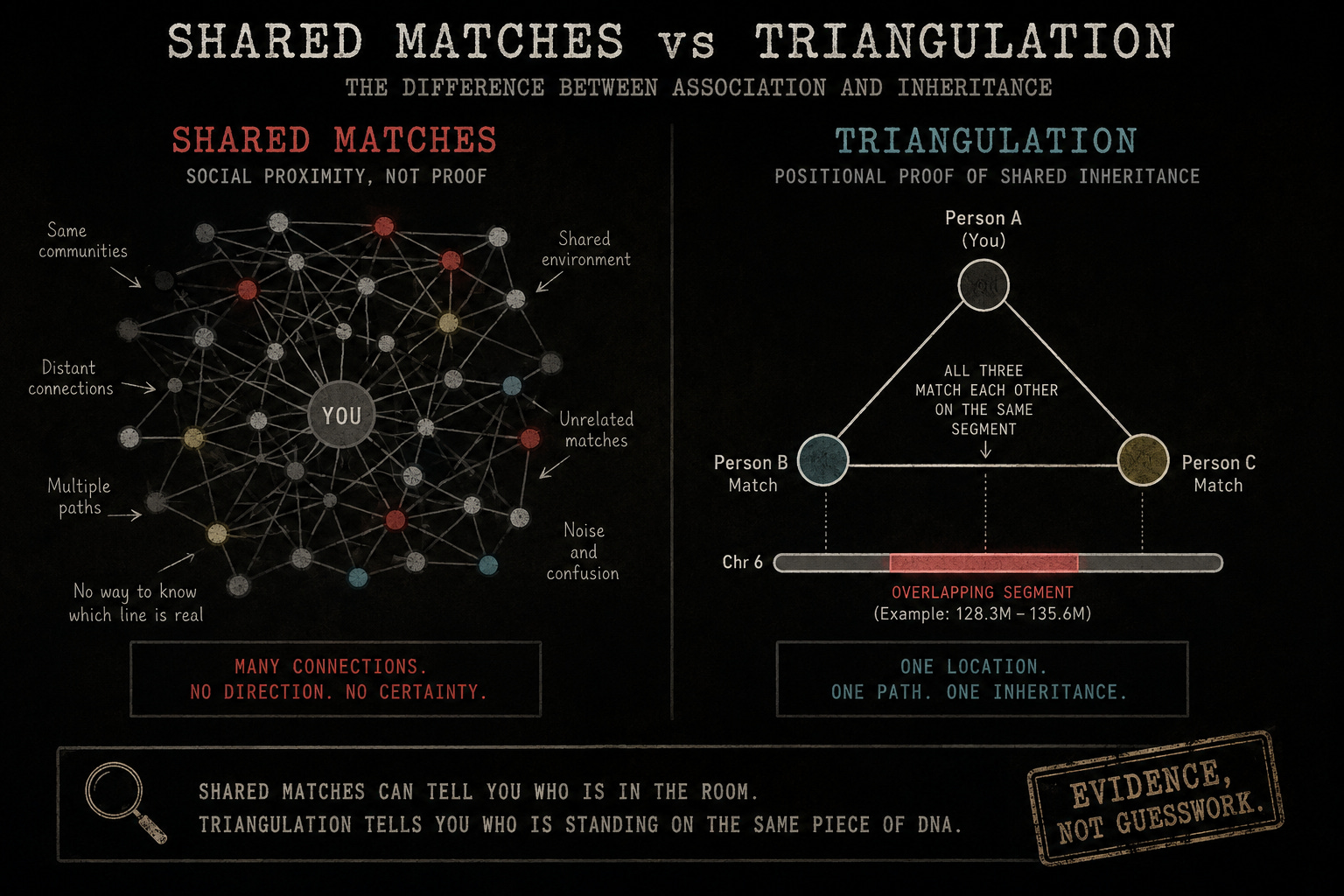
Shared matches can tell you that people are hanging around the same neighborhood of DNA. Chromosome mapping tells you whether they are standing on the same floor, in the same room, touching the same bloodstain.
That matters.
Because in a case like Earl’s, total centimorgans can lie by omission.
A 94 cM match can look important.
A 27 cM match can look small.
An 8 cM segment can look like noise.
But structure matters more than size.
Where is the match?
Who else matches there?
Do they match each other?
Are they on the same chromosome segment?
Can the segment be assigned to a known side?
Does it survive maternal exclusion?
Does it connect to a tree, a surname, a place, a migration corridor?
That is the difference between chasing glitter and building a case.
What chromosome mapping actually means
Here is the plain-English version.
You have 22 numbered chromosomes, plus sex chromosomes. Each one is a long biological document inherited in chunks from your ancestors.
When two people share a segment of DNA, it means they inherited the same stretch from a shared ancestor somewhere back in time.
But one shared segment between two people is not enough.
That is just a match.
Triangulation is stronger.
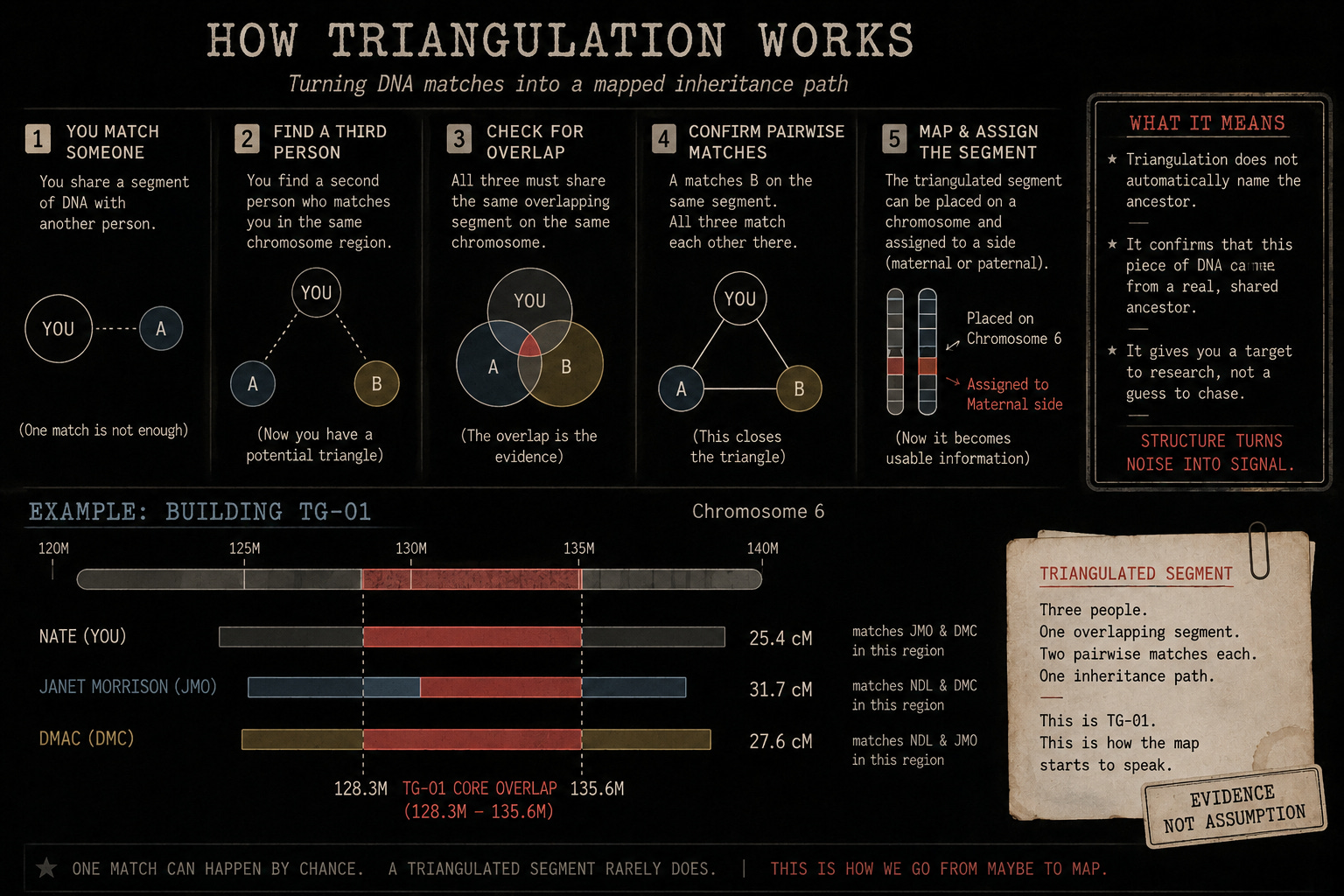
Triangulation means three or more people all share the same overlapping segment of DNA, and they match each other on that same segment.
That is when the room changes.
That is when the DNA stops being a rumor and starts acting like a witness.
A triangulated segment does not automatically name the ancestor. It does not solve the case by itself.
But it says:
This piece of DNA came from somewhere real. Find the line that carried it.
That is the work.
Not guessing.
Not wishing.
Not building a beautiful tree made of wet cardboard.
Mapping.
Enter TG-01
The first major stabilized triangulation group in this phase is what I am calling TG-01.
TG-01 sits on Chromosome 6.
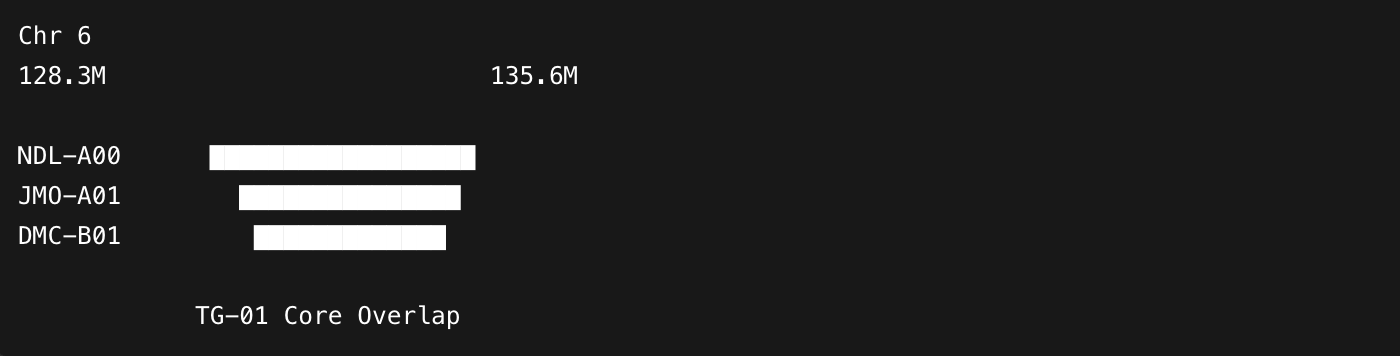
The core overlap is approximately:
Chromosome 6: 128,334,236 to 135,623,833
That is the shared stretch where the signal holds.
The confirmed TG-01 working group currently includes my control kit, NDL-A00-Control, plus two privacy-coded independent matches: JMO-A01-N16cM and DMC-B01-N20cM.
I am using privacy codes for living or potentially living DNA matches throughout this post. The project can be transparent without turning private people into public evidence mannequins. The DNA matters. The structure matters. The privacy stays intact.
The important part is not that my kit matches one person.
And it is not that my kit matches another person.
The important part is that the two independent TG-01 matches also match each other across the same overlapping Chromosome 6 segment.
That third side matters.
That is the triangle.
That is the difference between “interesting” and “put this in the evidence locker.”
GEDmatch one-to-one comparisons verified the pairwise overlap. DNA Painter then gave the segment a physical home on the chromosome map.
So TG-01 is no longer just a name in a spreadsheet.
It is a mapped genetic location.
A coordinate.
A small buried wire running through multiple people.
The Cleanup Mattered
This is where the work got less glamorous and more important.
At first, more matches looked connected to TG-01.
That sounds exciting until you remember that genealogy loves a crowd. It will pack the room with cousins, siblings, ghosts, duplicate clues, and one guy in the corner holding a tree from 2009 with no sources and the confidence of a pirate dentist.
But not every matching person counts as an independent triangulation point.
That is the trap.
A family cluster can make a segment look more broadly confirmed than it really is. Close relatives of an existing match can help support that side of the segment, but they do not count as separate independent anchors.
That distinction matters.
So I cleaned the group.
Additional matches connected to DMC-B01-N20cM help support that side of the segment, but because they appear to be close family connections, they are not counted as independent triangulation anchors.
A related match on the JMO-A01-N16cM side helps confirm that branch of the segment, but because the match appears closely connected, I am not counting it as a separate independent triangulation point.
That does not make them useless.
It makes them properly classified.
And proper classification is everything in this kind of work.
Bad genealogy loves a crowded chart.
Good genealogy asks who actually belongs in the room.
Right now, the independent TG-01 structure is clean and limited: my control kit, JMO-A01-N16cM, and DMC-B01-N20cM.
That is the working group.
No confetti.
No inflated claims.
No “look how many people match” carnival barking.
Just the structure that survives the cleanup.
What TG-01 proves
TG-01 does not prove who Earl’s parents were.
Let me say that clearly, before the genealogy goblins start tap dancing on the keyboard.
It does not identify the ancestor.
It does not prove a Douglas line.
It does not prove a McKay line.
It does not prove County Mayo, Scotland, Ontario, Nova Scotia, Duluth, or any other place by itself.
What it proves is narrower, and that is exactly why it matters.
TG-01 proves one thing clearly: my control kit and two privacy-coded independent matches, JMO-A01-N16cM and DMC-B01-N20cM, share a real overlapping autosomal DNA segment on Chromosome 6, verified through GEDmatch.
That is a stable genetic signal.
Now the question becomes:
What ancestral line carried that signal?
That is the hunt.
The names and places around this project are starting to apply pressure. Certain surnames recur. Certain migration corridors keep resurfacing. Ireland, Scotland, Canada, and Minnesota are not random wallpaper anymore. They may be part of the machinery.
Not proof.
But pressure.
The kind of pressure that starts to bend the investigation toward certain corridors and away from others.
