

Hypothesis Report: John Breed Douglas as Candidate Biological Father of Earl Mack Douglas
Forensic Assessment of Genetic Evidence, Relationship Models, and Historical Feasibility

Abstract
This report evaluates the hypothesis that John Breed Douglas is the biological father of Earl Mack Douglas (b. 23 January 1896, Duluth, Minnesota), under a model in which Earl’s mother remains unidentified. Using autosomal DNA evidence from multiple descendants, including NJD and EDP-A1, the analysis tests competing relationship models against observed centimorgan values, segment structure, and generational expectations. The results reject a full-parental model involving John Breed Douglas and his documented spouse, while supporting a viable alternative in which John fathered Earl through an unknown maternal line.
The DNA evidence resolves into a pattern consistent with half-relationship structures. The signal is not diffuse. It is concentrated. Total shared DNA falls within moderate ranges, segment counts remain low, and the longest segments carry disproportionate weight. This is not the architecture of a full ancestral pair. It is the signature of a single-line descent.
The implication is structural, not interpretive: the genetic signal originates from one side of the pedigree.
Temporal alignment reinforces this model. John Breed Douglas was alive during the estimated conception window of April to May 1895, satisfying biological feasibility, yet deceased prior to Earl’s birth in January 1896. The timeline does not conflict with the genetic structure. It completes it.
Together, the DNA architecture and temporal constraints converge on the same conclusion:
This is not a two-parent signal.
It is a one-line event.However, the interpretation of both genetic and documentary evidence requires explicit consideration of historical context. Duluth, Minnesota, in the late nineteenth century was not an isolated frontier town but one of the most significant inland port cities in North America. As the western terminus of the Great Lakes shipping network, Duluth was directly connected to major population centers across New England and Western Canada via regular passenger and freight routes. This made it a critical corridor for migration, labor movement, and transient populations. Consequently, the pool of potential parental candidates is structurally expanded beyond locally documented residents, and assumptions of geographic isolation must be rejected.
While the hypothesis survives initial pressure testing and is supported by both genetic structure and temporal plausibility, it remains unproven. The current evidence establishes a connection to the John Breed Douglas family line but does not uniquely identify him as the biological father. Limitations include reliance on a single descendant branch, absence of triangulated segment confirmation, and lack of documentary evidence linking John directly to Earl’s unknown mother.
Future research will require expansion of descendant testing across independent lines, segment-level triangulation, and targeted historical investigation within Duluth’s documented social and occupational networks during the 1895 conception period.
At present, this hypothesis is best classified as a surviving candidate under structured evaluation rather than a confirmed conclusion.
1. Research Question
Evaluate whether John Breed Douglas could be the biological father of Earl Mack Douglas, with Earl’s mother remaining unknown.
This hypothesis assumes:
Earl was born out of wedlock or outside the documented Douglas household
John Breed Douglas fathered Earl with a woman not identified in existing records
2. Known Facts
DNA Testers
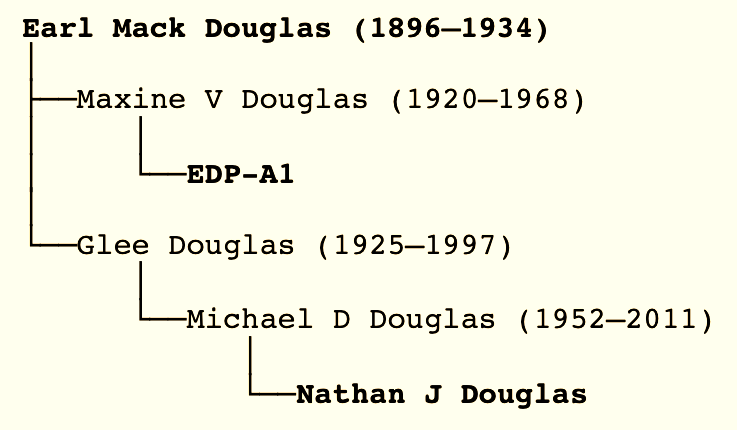
Nathan J. Douglas (user) – great-grandson of Earl M. Douglas
EDP-A1 – granddaughter of Earl
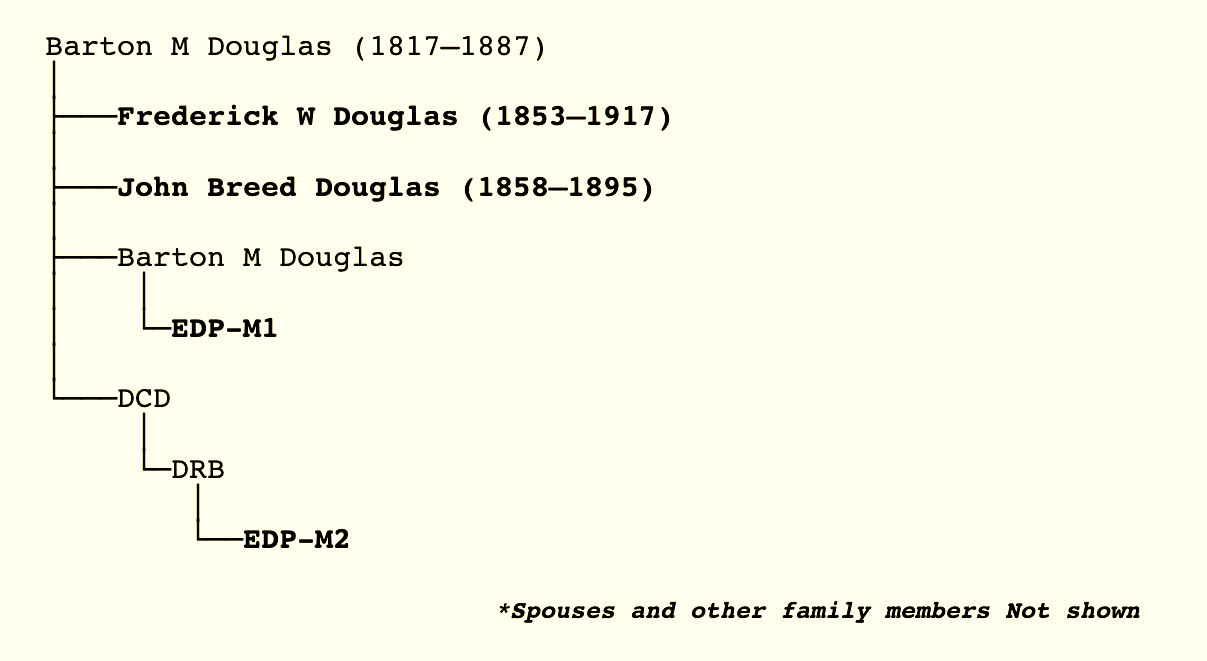
EDP-M1– descendant of John Breed Douglas (via Barton M. Douglas)
EDP-M2 – also descendant of John Breed Douglas (via DCD)
Earl Mack Douglas
Born: 23 January 1896, Duluth, Minnesota
Reported family tradition: Father died when Earl was approximately one year old
John Breed Douglas
Born: 1858
Died: December 1895
Residence: Brainerd and Duluth, Minnesota
3. DNA Evidence
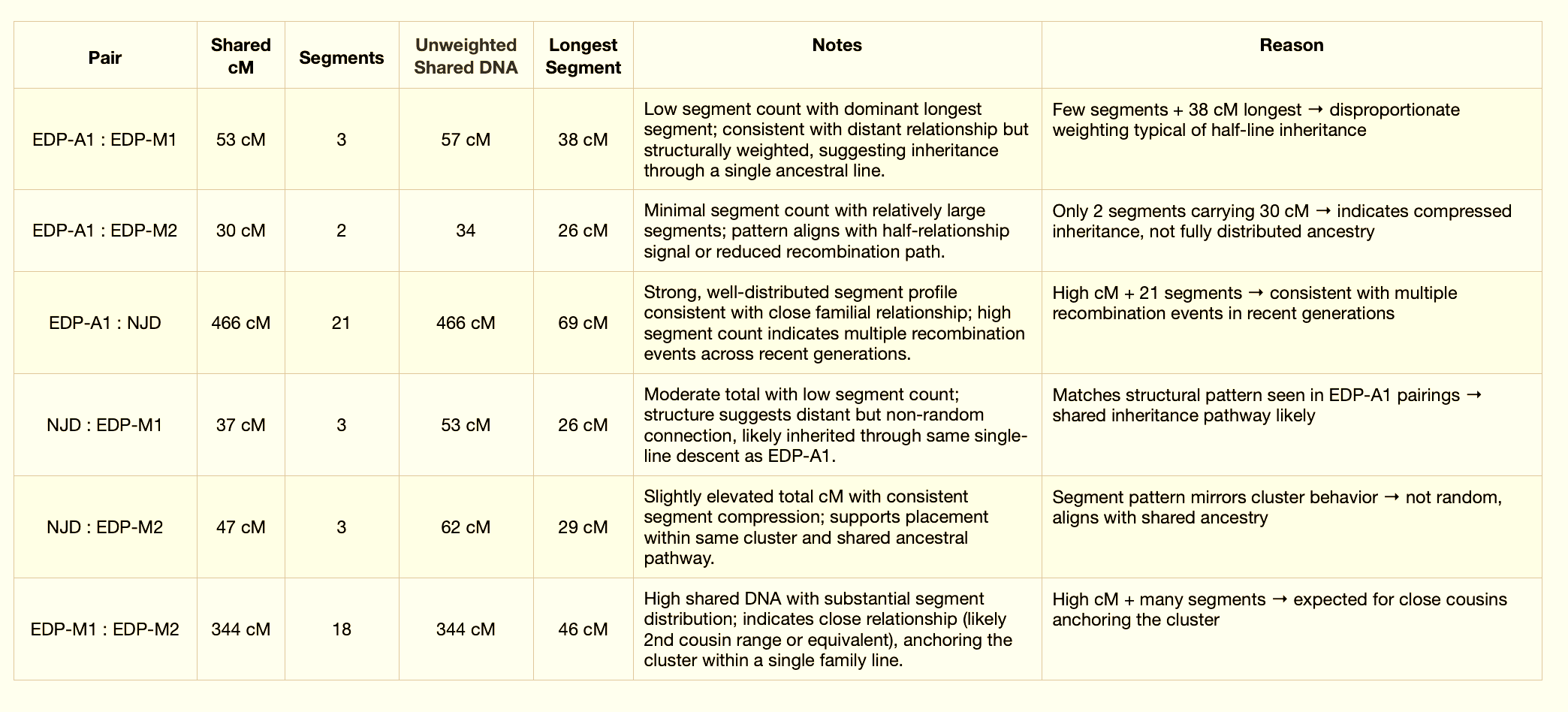
Observed Shared DNA
4. Relationship Models Tested
Model A: John Breed Douglas + Ellen S. Alderman as parents of Earl
Predicted relationships:
EDP-A1 ↔ EDP-M1 = 2nd Cousins
NJD ↔ EDP-M1 = 2C1R
Similar elevations across all comparisons
Evaluation:
All observed cM values fall below expected ranges
Pattern is consistently low across all comparisons
Conclusion:
❌ Model A is not supported
Model B: John Breed Douglas as father, unknown mother
Predicted relationships:
Half relationships (half 2C, half 2C1R, half 3C equivalents)
Evaluation:
Observed values fall within plausible ranges for half relationships
No systematic over- or under-performance relative to expectations
Conclusion:
✅ Model B remains viable
5. Segment Structure Analysis
The matches show a consistent pattern:
Moderate total cM
Few segments
Large longest segments relative to total
Examples:
53 cM total with 38 cM longest
30 cM total with 26 cM longest
Interpretation
This indicates:
A real genealogical connection
Likely inherited through a single ancestral line rather than a full couple
Compatible with half-relationship descent
This pattern does not resemble the broader, more distributed segment structure typical of full 2nd cousin relationships.
6. Temporal Feasibility
Conception Window
Estimated: April–May 1895
John Breed Douglas
Alive during conception window
Died: December 1895
Assessment
Biological paternity is fully feasible
Death occurs:
Before Earl’s birth
After conception
During pregnancy
7. Family Tradition Conflict
Reported statement:
“Earl’s father died when he was one year old”
Conflict
John died before Earl’s birth, not when Earl was one
Interpretation
This discrepancy is not disqualifying, for several reasons:
Oral history compression
Early childhood timelines are frequently imprecise
Possible social vs biological father confusion
Statement may refer to a different man
Narrative smoothing over time
Common in undocumented parentage cases
Conclusion:
⚠️ This introduces tension, but does not invalidate the hypothesis
8. Structural Limitations of Current Evidence
1. Single descendant branch
Both EDP-M1 and EDP-M2 descend from:
Barton M. Douglas (1886–1980)
No independent confirmation from other children of John
2. Lack of triangulation
Shared segments have not yet been:
Compared across all testers
Confirmed as identical overlapping segments
3. Non-unique candidate
Other Douglas males in the same family network may:
Produce similar DNA signatures
Current data supports the family line, not uniquely John himself
9. Strengths of the Hypothesis
DNA matches align with half-relationship expectations
Segment structure supports single-line descent
Geographic overlap (Brainerd / Duluth) is strong
Timeline allows biological feasibility
Multiple independent testers (NJD + EDP-A1) connect to the same branch
10. Weaknesses of the Hypothesis
Matches originate from only one descendant line
No documentary evidence placing John in:
Direct contact with Earl’s mother
Duluth specifically during conception period
Family tradition introduces a chronological discrepancy
No triangulated segment confirmation yet
11. Conclusion
The hypothesis that John Breed Douglas is the biological father of Earl Mack Douglas:
❌ Is not supported if assuming John and Ellen S. Alderman as parents
✅ Remains plausible under a model where:
John fathered Earl with an unknown woman
Current Status
Survives initial pressure testing, but is not yet proven
The DNA evidence supports:
Descent from the John Breed Douglas family line
Through a half-relationship pathway
It does not yet uniquely identify John Breed Douglas as the specific father.
12. Platform Limitation: Absence of Segment-Level Verification
Current analysis is constrained by the fact that all referenced DNA matches are located exclusively on AncestryDNA, with no corresponding kits available on GEDmatch.
As a result:
Chromosomal positions of shared segments cannot be observed
Segment overlap cannot be verified across multiple testers
True triangulation is not possible within the current dataset
Identical-by-descent (IBD) vs coincidental overlap cannot be distinguished
This limitation is structural, not procedural.
Ancestry provides:
Total shared DNA (cM)
Segment count
Longest segment
But does not provide:
Chromosome numbers
Start/End positions
Segment alignment across matches
Implication for Interpretation
All conclusions in this report are therefore based on:
Statistical inference (centimorgan values)
Segment structure patterns (distribution and weighting)
Cluster association (shared matches)
These methods are sufficient to:
✔ Identify likely ancestral lines
✔ Evaluate relationship models
✔ Eliminate incompatible hypotheses
But are insufficient to:
❌ Confirm a specific shared segment from a single ancestor
❌ Establish triangulated descent
❌ Uniquely identify an individual as the biological parent
Operational Consequence
Until at least two additional matches from this cluster:
Upload to GEDmatch (or another platform with a chromosome browser), and
Demonstrate overlapping shared segments with NJD and each other
…the current hypothesis remains:
Structurally supported, but not segment-verified
Conclusion (Revised Integration)
The hypothesis that John Breed Douglas is the biological father of Earl Mack Douglas remains viable under a single-line paternal model but is not yet proven. The DNA evidence supports a connection to the John Breed Douglas family line through a structure consistent with half-relationship inheritance; however, it does not uniquely identify John as the specific father.
All centimorgan values in this report originate from AncestryDNA. In the absence of a chromosome browser and cross-platform matches on GEDmatch, segment-level validation and triangulation remain unperformed.
Clustering analysis supports the presence of a Douglas-derived signal but cannot resolve segment-level inheritance or distinguish between multiple candidates within the same extended family.
Accordingly, the evidence identifies the family line, but not the specific segment or individual.
At present, this hypothesis survives pressure testing.
But it has not yet survived triangulation.
And until it does, it remains a candidate under investigation, not a confirmed conclusion.
Final Line
Centimorgans suggest.
Segments decide.
And until the segments align, the conclusion remains on trial.
Conclusion
The hypothesis that John Breed Douglas is the biological father of Earl Mack Douglas remains viable under a single-line paternal model but is not yet proven. The DNA evidence supports a connection to the John Breed Douglas family line through a structure consistent with half-relationship inheritance; however, it does not uniquely identify John as the specific father.
All centimorgan values referenced in this analysis were obtained from Ancestry.com. While sufficient for estimating relationships and evaluating structural patterns, the platform does not provide a chromosome browser. As a result, the exact chromosomal positions of shared segments cannot be determined, and true segment triangulation cannot be performed within this dataset.
Further limiting confirmation, none of the relevant matches, excluding NJD are currently available on GEDmatch, preventing cross-platform segment comparison. Without this, it is not possible to confirm whether shared segments are identical by descent (IBD) from the same ancestral source versus coincidental overlap.
Clustering tools within Ancestry offer a partial workaround. Shared Matches clustering can group individuals who likely descend from a common ancestral line, and in this case, the convergence of EDP-M1 and EDP-M2 within the same cluster supports the presence of a Douglas-derived signal. This is valuable for identifying which family system the DNA is coming from, especially in the absence of segment-level data.
However, clustering has critical limitations:
It operates on match overlap, not segment overlap
It cannot confirm whether individuals share the same DNA segment
It may group matches who relate through different ancestors within the same extended family
It cannot distinguish between multiple candidates within a surname cluster
In effect, clustering can identify the neighborhood, but not the exact address.
Accordingly, the conclusions presented here are structurally supported but not segment-verified. The evidence demonstrates a consistent and meaningful connection to the John Breed Douglas family line, but lacks the resolution required for definitive identification.
At present, this hypothesis survives pressure testing.
But it has not yet survived triangulation.
And until it does, it remains a candidate under investigation, not a confirmed conclusion.
Addendum: Phase II Plan for Segment-Level Validation Using GEDmatch and DNA Painter
Purpose
To advance the current hypothesis beyond centimorgan-based inference by introducing segment-level analysis, triangulation, and cross-platform validation, using GEDmatch and DNA Painter.
This phase is designed to answer one question the current dataset cannot:
Are these matches sharing the same piece of DNA from the same ancestor… or just orbiting the same surname from different directions?
1. Strategic Shift
Phase I established:
A family-level signal (Douglas line)
A plausible half-relationship structure
A surviving paternal candidate
Phase II shifts from:
“How much DNA is shared?”
to:
“Where is it shared, and is it the same segment?”
Because that’s where theories either crystallize… or collapse.
2. GEDmatch Entry Strategy
Objective
Build a segment-verified cluster using testers who:
Match NJD and/or EDP-A1
Are willing to upload to GEDmatch
Represent multiple branches within the suspected Douglas network
Priority Targets
Existing Ancestry matches with:
20–100 cM range
Douglas-linked trees
Shared match overlap with EDP-M1/ EDP-M2 cluster
New recruits:
Descendants of other children of John Breed Douglas
Matches from adjacent surname clusters (McKay, Morrison, etc.)
3. One-to-One Segment Analysis
Using GEDmatch tools:
Step 1: Compare NJD↔ Target Match
Record:
Total cM
Segment count
Chromosome number
Start/End positions
Segment length (cM)
Step 2: Repeat Across Matches
Build a dataset of:
Segment coordinates
Overlapping regions
Repeated segment signatures
4. Triangulation Protocol
Goal
Identify triangulated groups where:
NJD ↔ Match A share segment X
NJD ↔ Match B share segment X
Match A ↔ Match B also share segment X
Criteria for Valid Triangulation
Same chromosome
Overlapping segment boundaries
≥10–15 cM preferred (your authority threshold)
Outcome
A confirmed triangulated segment represents:
A single ancestral source. No guessing. No ambiguity.
5. Integration with DNA Painter
Workflow
Using DNA Painter:
Create or expand NJD’s chromosome map
Assign triangulated segments to:
“Douglas cluster” (provisional label)
Track:
Segment stacking
Overlapping inheritance patterns
Segment persistence across multiple testers
Objective
Convert:
Abstract cM totals
Into:
Physical locations on chromosomes tied to specific ancestral hypotheses
6. Introduction of “Q” (Control Matches)
Definition
“Q matches” are:
Matches outside the Douglas hypothesis
Used as controls to test false positives
Purpose
To answer:
Is this segment truly Douglas… or just a common segment floating through the population?
Method
Run Q matches through the same GEDmatch comparisons
Check for:
Segment overlap with Douglas cluster
False triangulation signals
Interpretation
If Q matches share the same segment → segment is not unique
If Q matches do NOT share it → segment gains evidentiary strength
7. Expected Outcomes
Scenario A: Strong Confirmation
Multiple triangulated segments
Shared across independent Douglas descendants
No interference from Q matches
→ High-confidence ancestral assignment
Scenario B: Partial Support
Limited triangulation
Some overlap, some ambiguity
→ Hypothesis survives, but remains conditional
Scenario C: Collapse
No triangulated segments
Segments fail to align across matches
Q matches overlap significantly
→ Hypothesis rejected
8. Risk Factors and Constraints
Limited tester participation
Incomplete uploads to GEDmatch
Endogamy or population-level segment noise
False clustering from shared geography rather than ancestry
9. Operational Mindset
This phase is not about confirming a story.
It’s about breaking it.
Because if a hypothesis survives:
cross-platform testing
segment alignment
triangulation
and control comparison
Then it’s no longer just plausible.
It’s anchored.
Receipts
Blaine T. Bettinger, The Family Tree Guide to DNA Testing and Genetic Genealogy (Cincinnati: Family Tree Books, 2019).
Blaine T. Bettinger, “The Shared cM Project 4.0 Tool,” DNA Painter, 2020, https://dnapainter.com/tools/sharedcmv4.
International Society of Genetic Genealogy (ISOGG), “Autosomal DNA Statistics,” last modified 2024, https://isogg.org/wiki/Autosomal_DNA_statistics.
International Society of Genetic Genealogy (ISOGG), “Identical by Descent (IBD),” https://isogg.org/wiki/Identical_by_descent.
Jim Bartlett, “Triangulation,” Segmentology (blog), https://segmentology.org.
Kitty Cooper, “Chromosome Mapping,” Kitty Cooper’s Blog on DNA, https://dna-explained.com.
Bettinger, Family Tree Guide, chapters on segment analysis and triangulation.
AncestryDNA, “DNA Matches,” Ancestry Support, https://support.ancestry.com.
Bettinger, Family Tree Guide, discussion of platform differences (Ancestry vs GEDmatch vs MyHeritage).
GEDmatch, “One-to-One DNA Comparison Tool,” https://www.gedmatch.com.
DNA Painter, “Chromosome Mapping Tool,” https://dnapainter.com.
Board for Certification of Genealogists, Genealogy Standards, 2nd ed. (Nashville: Ancestry, 2019).
William Cronon, Nature’s Metropolis: Chicago and the Great West (New York: W.W. Norton, 1991).
United States Census Bureau, “Historical Census Records,” https://www.census.gov.
Minnesota Historical Society, “Duluth and Lake Superior Port History,” https://www.mnhs.org.
Your posts have me on an emotional roller-coaster! Thinking of the"many ponds" approach, have you tested with MyHeritage or 23andMe?
Great to see your step by step analysis. I know your focus is on the father at the moment but it did make we wonder if you have any matches clustered around a possible unidentified mother ... that is, an unlinked cluster that may be relevant?